Chess IQ

Chess IQ: test your chess skill in six positions

There is no official "chess IQ" score, but you can test your chess skill right here: six positions, two minutes. Chess strength is measured by ratings such as Elo or Glicko-2 and by how accurately you play. IQChess is a chess-training app, not an IQ test: it measures exactly that and trains it with an AI coach.

Free on iPhone, Android and the web · 20+ languages

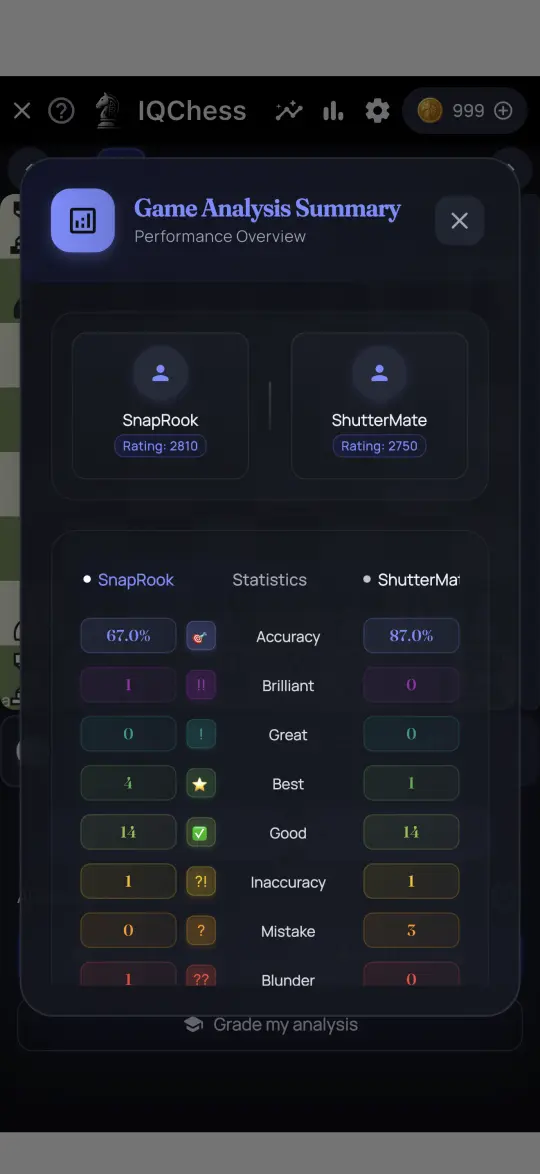
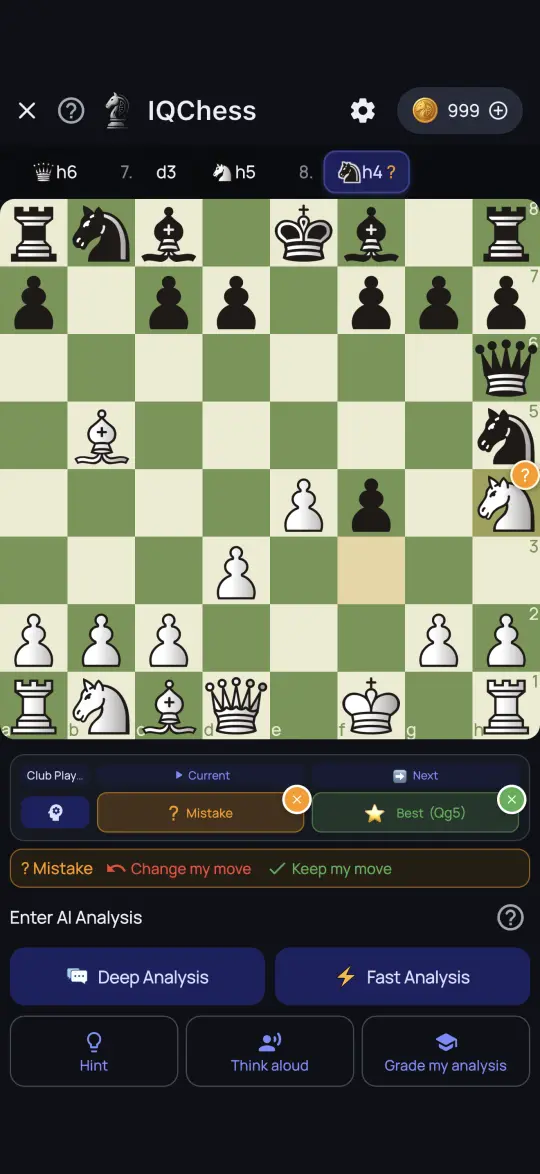
IQChess app: Game report
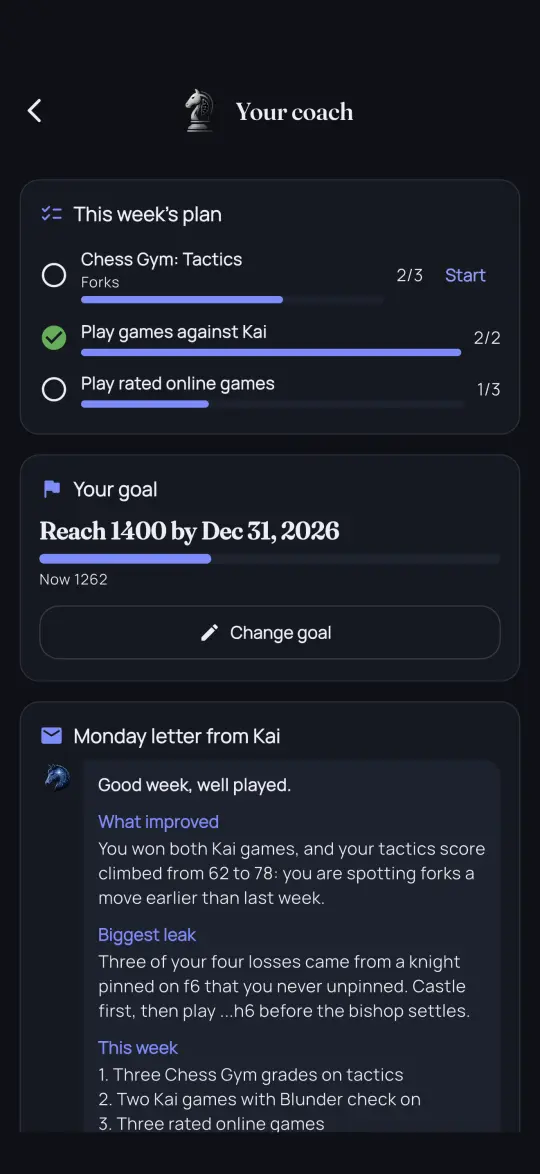
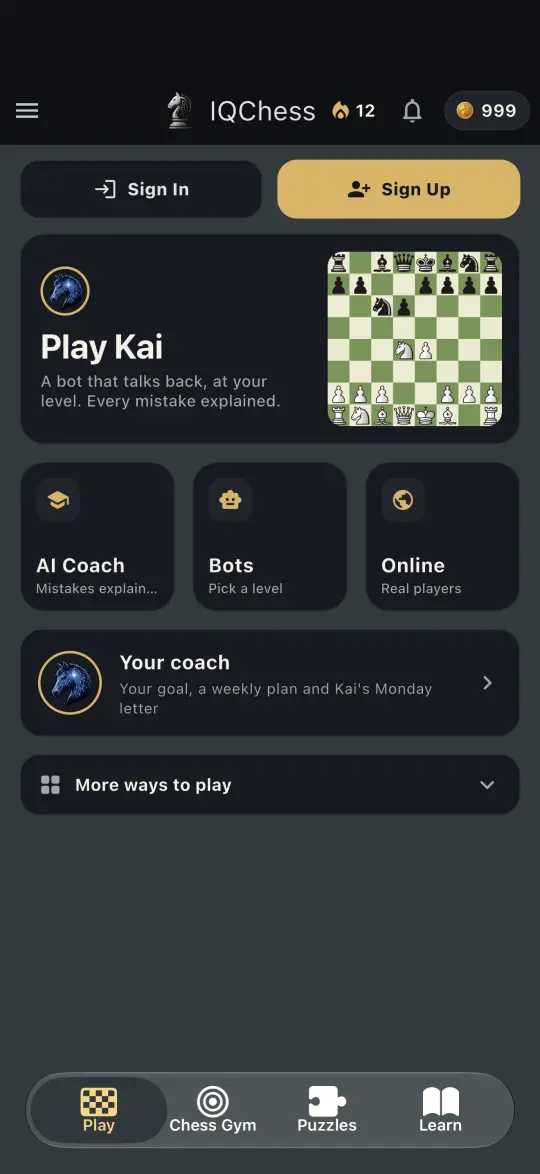
IQChess app: Your coach
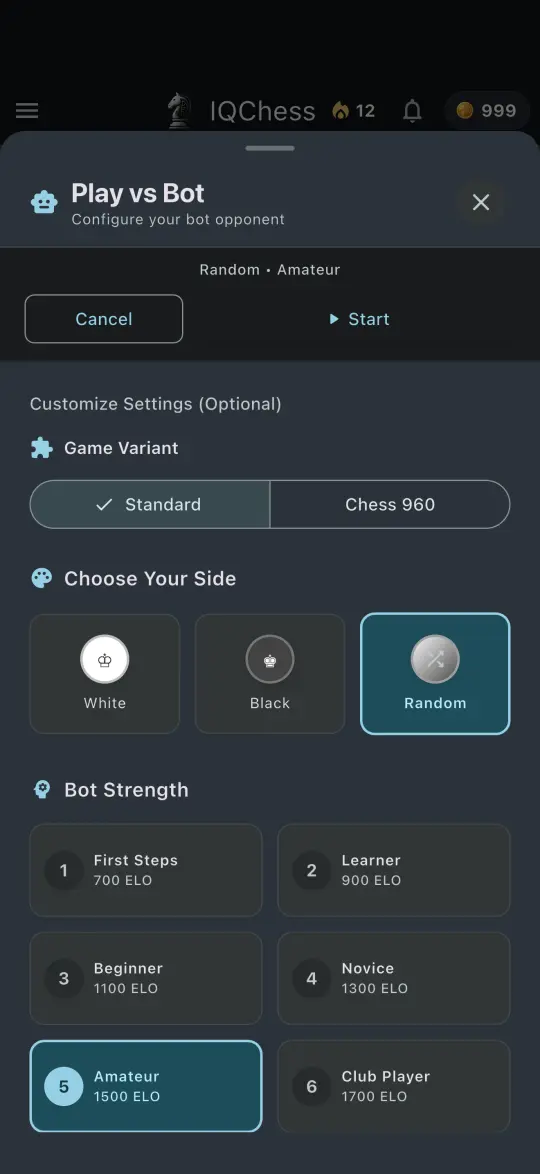
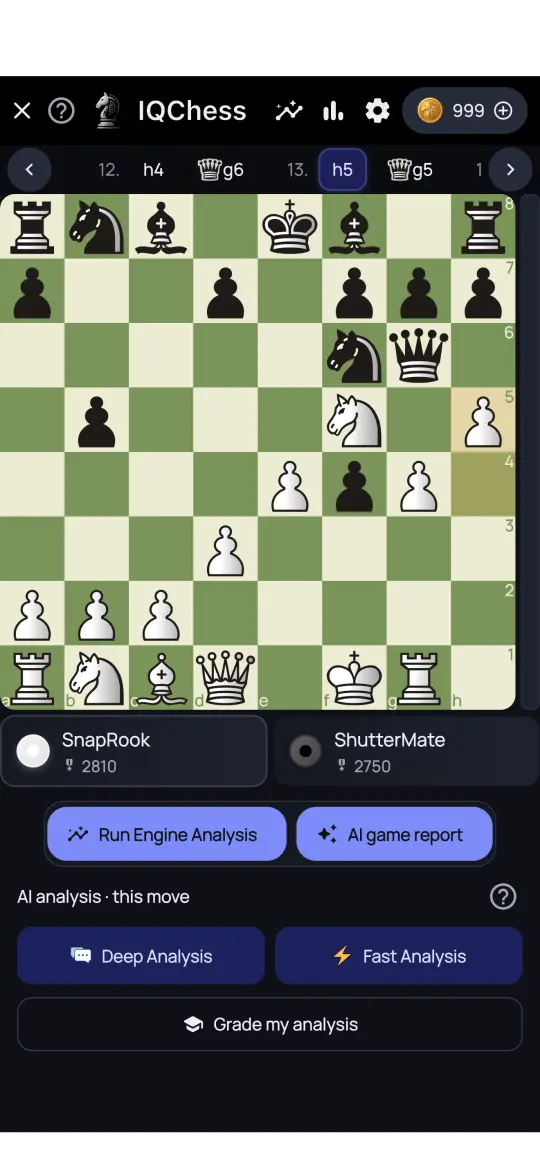
IQChess app: Play the computer
Every move checked by a chess engine
Answers in your language
91free lessons
10bot levels
20+languages
3platforms
Chess IQ check

Six positions. How many can you solve?

Find the best move or spot the threat, then see what your score says about your level. No sign-up; it runs on this page. It measures chess skill, not IQ.

Position 1 of 6Beginner

White to move. Black has just played 3…nf6. What is the best move?

Show the answer

is checkmate: the queen takes f7, protected by the bishop on c4, and the king has no square. This is Scholar's mate, the first pattern every beginner learns to spot and to stop.

Tap a move to play it on the board.

Position 2 of 6Beginner

White to move. Black has just played 4…qh4. What is Black threatening?

Show the answer

is the threat: f2 is defended only by the king, and the bishop on c5 protects the queen. Checking the opponent's threat before every move is the habit that saves the most games. Nf3?? would still allow the mate; g3 or Qf3 stops it.

Tap a move to play it on the board.

Position 3 of 6Improving

White to move. Your knight on e4 is attacked by the bishop and the rook. What is the best move?

Show the answer

is a fork: the knight attacks the king and the queen at once. After it takes the queen on d7. The knight was attacked, but the answer was not to run; it was a check that hits two pieces.

Tap a move to play it on the board.

Position 4 of 6Improving

White to move. The knight on d5 is pinned to the king by the bishop on c4. How do you win it?

Show the answer

e4 attacks the pinned knight, which cannot move without exposing the king. Whatever Black does, follows, and after … White is a piece up. Taking at once with Bxd5 only trades: qxd5 Qxd5+ cxd5.

Tap a move to play it on the board.

Position 5 of 6Club

White to move. Black's king is boxed in on h8. Find the forced mate.

Show the answer

forces , and is a smothered mate: the king on h8 is boxed in by its own rook and pawns. Nf7+ at once wins material but no more, because Black answers rxf7. The pattern is called Philidor's legacy.

Tap a move to play it on the board.

Position 6 of 6Club

White to move. King and pawn against king: only one move wins. Which?

Show the answer

takes the opposition: the kings face each other with one square between them, and Black must give way. After (or kd5 Kf4) the white king gets in front of its pawn and escorts it home. Every other move, pushing the pawn included, lets Black hold the draw.

Tap a move to play it on the board.

Your result0 / 6

Beginner territory. Players here are usually rated under 1000 online. The free lessons and the daily puzzle are the fastest way up.

An improving player, roughly 1000 to 1500 online. You see the one-move ideas; the two-move ones are next, and the Chess Gym and the AI game report are built for exactly that.

Club strength or better, roughly 1500 and up online. Deep analysis and written-analysis grading in the Chess Gym will stretch you.

Six positions are a snapshot, not a rating. In IQChess, puzzle and game ratings measure the same skill over hundreds of positions, and the AI coach explains every mistake along the way.

How it works

What it does for your game

No official chess IQ test exists, but you can check your chess skill here: six verified positions, what ratings and levels mean, and how to raise yours.

Is chess linked to intelligence?

Somewhat. A 2016 meta-analysis of 19 studies (Burgoyne et al., Intelligence, vol. 59) found a modest link between general cognitive ability and chess skill, stronger in younger and less experienced players. Deliberate practice, studying positions, tactics and your own mistakes, explains much of the rest, which is why chess skill can be trained.

How IQChess measures your chess

You get separate ratings for games and for each puzzle type, an accuracy percentage for every game, and 0-100 scores in the Chess Gym by topic: best move, evaluation, king safety, pawn structure, tactics, threats and plans. Your weak spots list the themes where you lose the most.

How to raise it

Solve a daily puzzle, review every game with the AI report, and train your weakest theme in the Chess Gym. Beginners can start with 91 free lessons, from the rules to advanced endgames.

Ratings explained

What chess ratings mean

There is no chess IQ scale, but a rating does the same job: it places you on a ladder and moves with every result.

RatingLevelWhat it usually looks like
Under 800BeginnerKnows the rules. Pieces are left hanging and one-move threats are missed.
800–1200Casual playerSees one-move captures and threats; two-move tactics and the opponent's ideas still slip by.
1200–1600Club playerBasic tactics are automatic. Openings, plans and endgames decide the games.
1600–2000Strong club playerCalculates several moves ahead and plays with a plan; the remaining mistakes are positional more than tactical.
2000–2200ExpertTournament strength. The US Chess Expert title starts at 2000.
2200 and upMasterFIDE titles begin here: Candidate Master at 2200, FIDE Master at 2300, International Master at 2400 and Grandmaster at 2500, the last two with tournament results (norms) as well.

Online ratings sit on different scales from each other and from over-the-board ratings: the same player can be 1500 on one site and 1200 on another. Compare yourself within one system.

Elo and Glicko-2

Elo, used by FIDE since 1970, moves your rating by a fixed share of the surprise in each result: beating a stronger player gains more than beating a weaker one. Glicko-2 also tracks how sure the system is about your rating: a new player's number moves fast and settles as the uncertainty shrinks. IQChess rates online games with Elo and each puzzle type with Glicko-2, so your tactical and positional puzzle ratings can differ.

How to estimate your level

  1. Take the six-position check above for a first snapshot.
  2. Play 20 or more rated games against people: a rating needs results to settle, and the first games move it the most.
  3. Solve puzzles until that rating stops jumping; it measures tactics on their own, so it often differs from your game rating.
  4. Read your accuracy and your weak spots in the game report: two players at the same rating lose to very different mistakes.
Get started

Three steps to start

  1. Play a few games and solve puzzles to get your ratings.
  2. Open Your weak spots to see which themes cost you most.
  3. Train those themes with lessons and Chess Gym drills.
Inside the app

See it on your phone

Real IQChess screens. Swipe, or tap one to see it full size.

IQChess app: Chess Gym
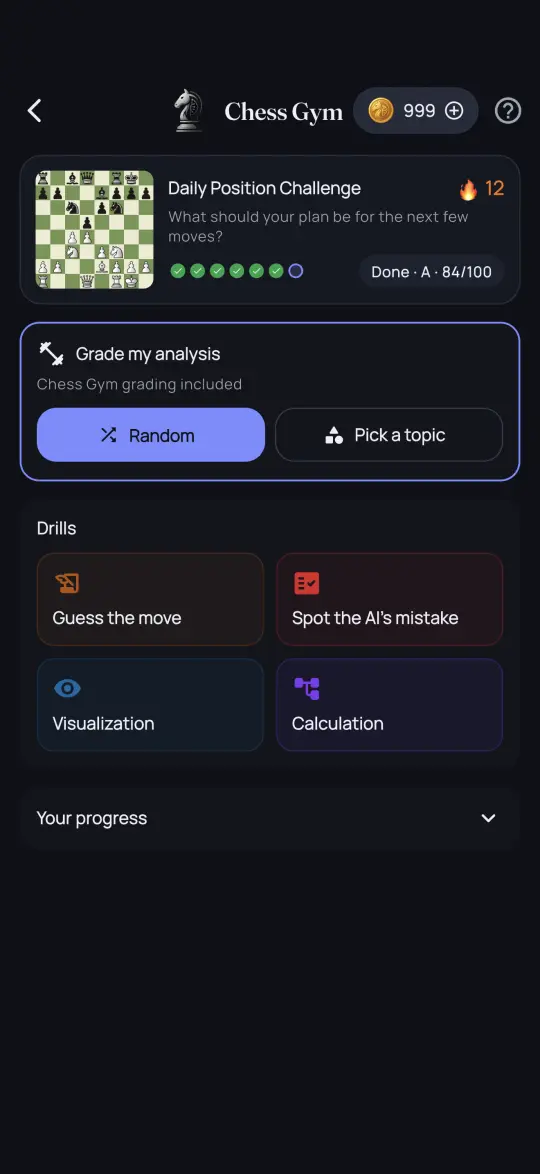
Chess GymWrite your own analysis and get it graded, with drills for calculation and visualization.
IQChess app: Kai catches a blunder
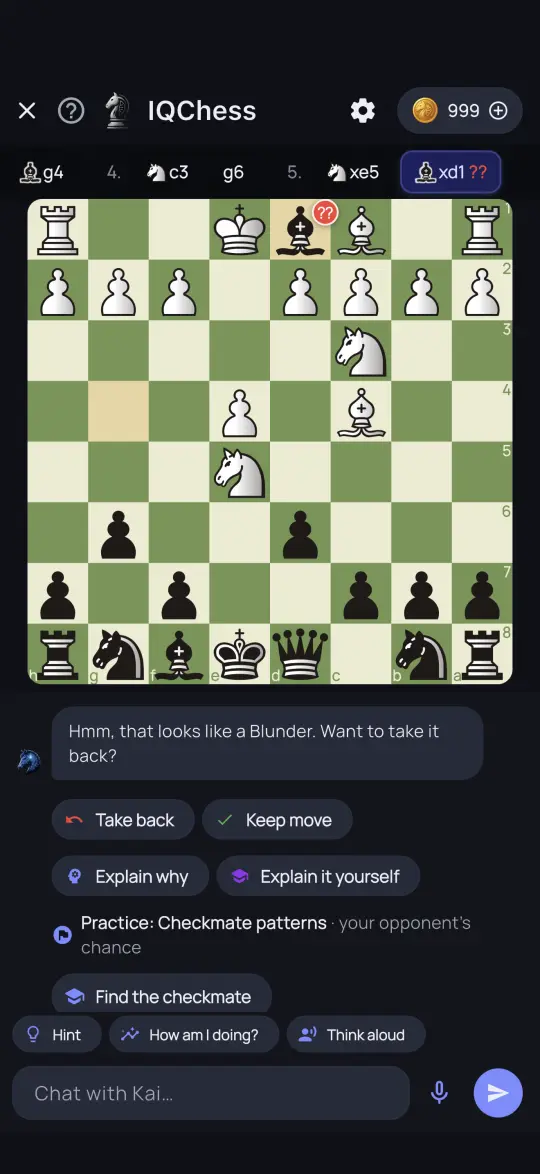
Kai catches a blunderKai stops a losing move and offers to take it back or explain it.
IQChess app: Ask Kai anything
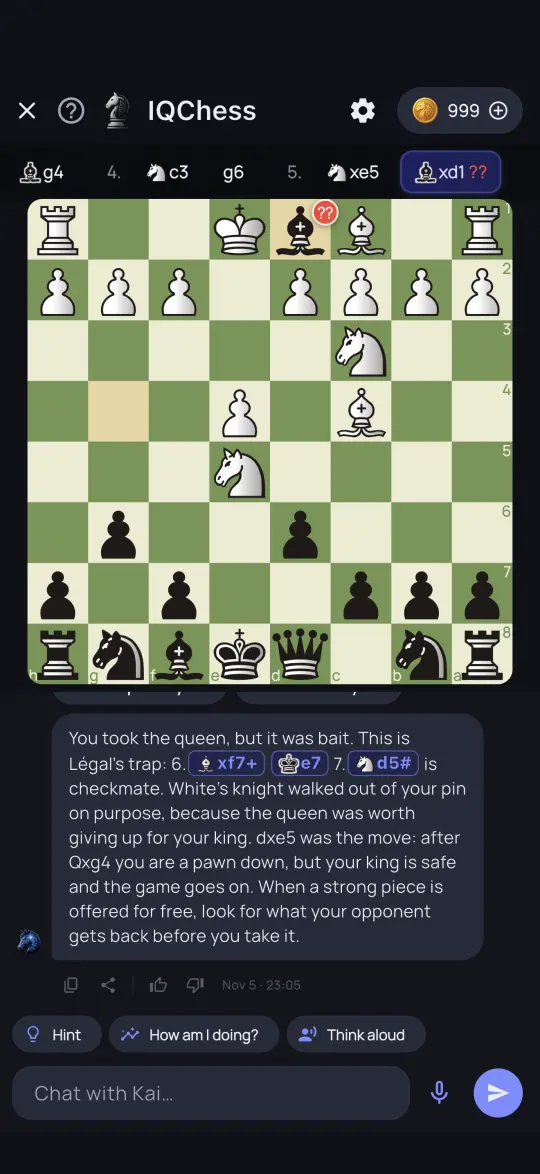
Ask Kai anythingKai answers about the game you are playing, in your language.
IQChess app: AI coach while you play
AI coach while you playFast and Deep analysis on any move, with the reason in plain words.
IQChess app: AI analysis
AI analysisCandidate moves, threats and plans, every move checked by the engine.
IQChess app: Game report
Game reportAccuracy for both sides and the moments that decided the game.
IQChess app: Play the computer
Play the computerTen bot levels, from a complete beginner to seriously strong.
IQChess app: Everything in one app
Everything in one appPlay, puzzles, lessons, the Chess Gym and online games.
FAQ

Questions, answered

Still curious? Read every answer.

Is there a chess IQ test?

No standard chess IQ test exists. Chess strength is measured by ratings like Elo or Glicko-2 and by game accuracy. IQChess gives you puzzle and game ratings, accuracy for every game and Chess Gym scores, which together show your level and what to train.

Does playing chess raise your IQ?

Not measurably. A 2016 meta-analysis of chess training studies (Sala and Gobet, Educational Research Review, vol. 18) found that well-controlled studies show little transfer to general skills. Chess does build chess-specific skills, such as calculation, pattern recognition and planning, and those improve with practice.

What does my score on the chess IQ check mean?

Six positions are a snapshot, not a rating. Zero to two right is beginner territory, three or four is an improving player, five or six is club strength. Rated games and puzzles in the app measure the same skill over hundreds of positions.

What is a good chess rating?

Most people who play online are rated somewhere between 800 and 1500, depending on the site; above 2000 you are in a small minority, and FIDE titles start at 2200. A good rating is one that is higher than it was last month.

What is the difference between Elo and Glicko-2?

Both estimate strength from results. Elo moves your rating by a fixed share of the surprise in each game. Glicko-2 also tracks how certain the rating is, so a new player's rating moves fast and settles as the uncertainty shrinks. IQChess uses Elo for online games and Glicko-2 for puzzles.

How does IQChess measure my chess IQ?

With ratings for online games and for each puzzle type, an accuracy percentage for every game, 0-100 Chess Gym scores by topic, and a weak-spots list of the themes that cost you the most games. None of it is an IQ score; all of it shows what to train next.

Do grandmasters have high IQs?

Some do, but the research link between cognitive ability and chess skill is modest and weaker in stronger players. Expert strength is mostly trained knowledge: thousands of patterns, recognised fast. That is good news, because it can be learned.

Is the chess IQ check free?

Yes. It runs on this page, with no account and no download. The app's puzzles, ratings and the daily Chess Gym challenge are free too.

Free lessons

91 lessons, from zero to advanced

The chessboardRows, columns and the centreSetting up the piecesThe rookThe bishopThe queenThe kingThe knightThe pawnPut it togetherHow to captureUnder attackProtecting your piecesCheckGetting out of checkCheckmateFind the checkmateStalemateCastlingPromotionEn passantWhat the pieces are worthDrawsStarting the game wellMate with king and queenThe rook ladderNaming the squaresWriting down movesYour first gameTake the free pieceDon't hang your ownWin materialBack-rank mateFind the checkmateSmothered mateKing and queenKing and rookTrap a pieceFight for the centreDevelop your piecesThe four-move checkmateCastle earlyThe Fool's MateLégal's MateSmothered in the openingThe Blackburne Shilling trapPunish a weak pawn moveHolding the gambit pawnWhat is a fork?Knight forksPawn forksQueen forksSpot the forkWhat is a pin?Winning with pinsWhat is a skewer?Skewer practiceWhat is a discovered attack?Discovered attack practiceCapture the defenderDeflectionThe oppositionThe rule of the squareThe Englund Gambit trapThe Kieninger trapThe Stafford Gambit trapThe Elephant trapNoah's Ark trapThe Fishing PoleThe Siberian trapThe Lasker trapThe copycat trapWeak pawnsPassed pawnsOutpostsGood and bad bishopsOpen filesDouble checkAttractionMate in twoThe Lucena positionPush the passed pawnSacrifice to winClearanceInterferenceX-rayQuiet movesZugzwangLong combinationsMate in threeConverting the endgameThe chessboardRows, columns and the centreSetting up the piecesThe rookThe bishopThe queenThe kingThe knightThe pawnPut it togetherHow to captureUnder attackProtecting your piecesCheckGetting out of checkCheckmateFind the checkmateStalemateCastlingPromotionEn passantWhat the pieces are worthDrawsStarting the game wellMate with king and queenThe rook ladderNaming the squaresWriting down movesYour first gameTake the free pieceDon't hang your ownWin materialBack-rank mateFind the checkmateSmothered mateKing and queenKing and rookTrap a pieceFight for the centreDevelop your piecesThe four-move checkmateCastle earlyThe Fool's MateLégal's MateSmothered in the openingThe Blackburne Shilling trapPunish a weak pawn moveHolding the gambit pawnWhat is a fork?Knight forksPawn forksQueen forksSpot the forkWhat is a pin?Winning with pinsWhat is a skewer?Skewer practiceWhat is a discovered attack?Discovered attack practiceCapture the defenderDeflectionThe oppositionThe rule of the squareThe Englund Gambit trapThe Kieninger trapThe Stafford Gambit trapThe Elephant trapNoah's Ark trapThe Fishing PoleThe Siberian trapThe Lasker trapThe copycat trapWeak pawnsPassed pawnsOutpostsGood and bad bishopsOpen filesDouble checkAttractionMate in twoThe Lucena positionPush the passed pawnSacrifice to winClearanceInterferenceX-rayQuiet movesZugzwangLong combinationsMate in threeConverting the endgame

Browse all lessons →

Start playing smarter today

Play, learn and get every move explained in plain language. Free on iPhone, Android and the web.