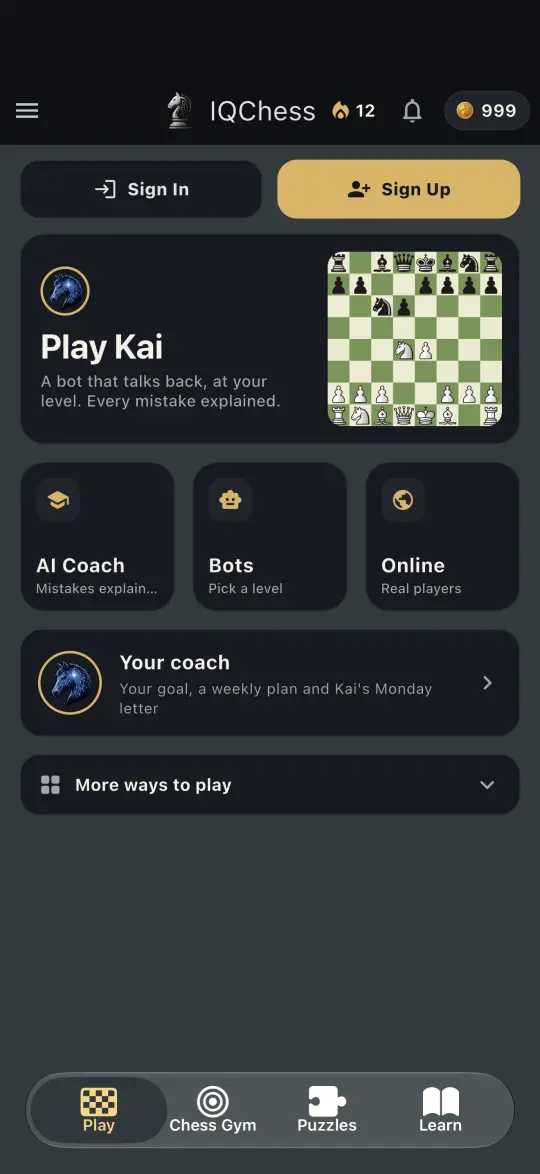
AI chess coach

An AI chess coach that explains every move

IQChess's AI coach answers the question an engine can't: why. Ask about any position and it explains plans, threats and mistakes in plain language, the way a human tutor would, with every move checked against a chess engine.

Free on iPhone, Android and the web · 20+ languages

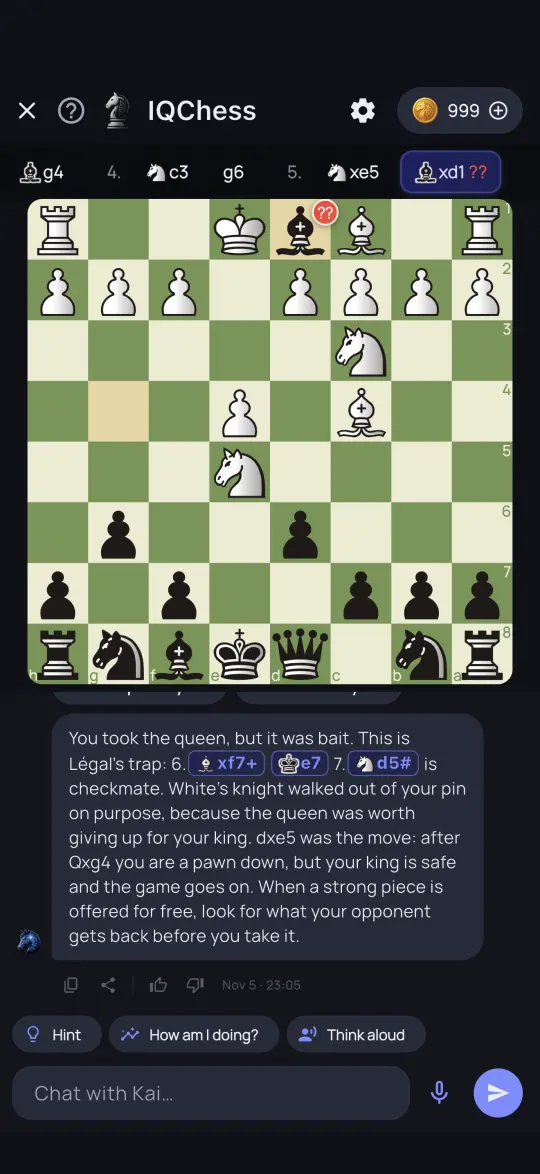
IQChess app: Ask Kai anything
IQChess app: AI coach while you play
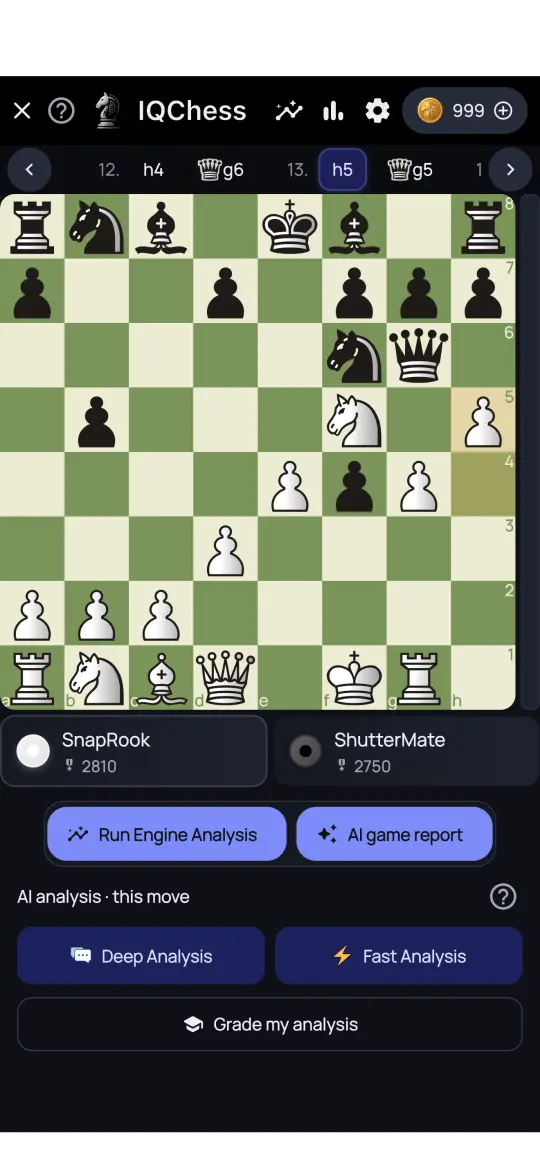
IQChess app: AI analysis
Every move checked by a chess engine
Answers in your language
91free lessons
10bot levels
20+languages
3platforms
How it works

What it does for your game

An AI chess coach that explains why a move is good or bad, in plain language and checked by a chess engine. Fast and deep analysis. Free to try.

How is it different from an engine?

A chess engine gives a number and a best move. The AI coach turns that into a reason: which piece is loose, what the opponent threatens, what plan fits the pawn structure. The facts come from a chess engine and board logic, so the coach does not invent moves; the language model only explains them.

Fast and deep analysis

Fast analysis reviews one move in a few seconds. Deep analysis goes further: candidate moves, tactics, plans and a conversation where you ask follow-up questions about the same position, with arrows drawn on the board.

Where it works

Use it on your own games, on games you import as PGN, during an AI Coach game against the computer, or in Kai's chat. Answers come in the language you write in, across 20+ languages.

A real example

The engine gives a number. The coach gives the reason.

One blunder, as a chess engine reports it and as the IQChess AI coach explained it. The coach text is real Fast-analysis output from the app, word for word.

What a chess engine says

After 1.e4 e5 2.Nf3 d6 3.Bc4 Bg4 4.Nc3 Nc6, White played 5.Nxe5.

Before the move
+0.6
After the move
−2.9
Best move
h3
Main line
c6

Evaluations in pawns from White's side. A number, a move and a line: that is all an engine gives you.

What the IQChess AI coach says

looks tempting — it grabs a pawn and even hits the bishop on g4 and knight on c6 — but the knight on e5 is simply undefended and attacked by both the knight on c6 and the pawn on d6, so it just drops a piece.

After the refutation runs (check), c6, , , — Black comes out roughly 3 points of material to the good, which is why your engine flagged it as a blunder.

The real problem is the pin: your knight on f3 is pinned by the bishop on g4, so you can't safely jump into e5. Instead, break the pin first with h3, hitting the bishop. A typical continuation is h3 bxf3 Qxf3 nf6 be7 — you recapture with the queen, keep material level, and stay comfortably in the game.

Fast analysis, intermediate setting, 8 November 2026. Tap a move to play it on the board.

Engine, chess AI or human coach?

Three ways to learn from a position

Chess engineIQChess AI coachHuman coach
What you getA number and a best line.The reason in plain words, built on the engine's facts, with arrows on the board.Judgment, a training plan and someone who knows your history.
WhenInstantly, any time.In seconds, any time: during a game against the computer or after any game.At lesson time.
Follow-up questionsNo.Yes: ask why, what if, and what to play instead, about the same position.Yes.
LanguageNotation.Yours, in 20+ languages.Whatever your coach speaks.
CostFree in IQChess: one engine review a day, unlimited with any plan.A free daily allowance; Fast analysis is included with Coach, Deep with GM.Usually billed by the hour.
Where it is weakIt never says why. A number is not a lesson.It explains the position in front of it; it cannot see your mood or sit with you for an hour.Expensive, and rarely available at 11 pm when the game just ended.

Most players do best with the engine for the truth, the AI coach for the reason and, if they have one, a human coach for the long game. IQChess puts the first two in your pocket.

Who it is for

Who an AI chess coach helps

Beginners

The engine says −3. The coach says your knight was pinned and shows the pin. Only the second one teaches anything. A beginner setting spells out every idea in plain words.

Club players

Ask about plans, pawn structure and the move you were afraid of. The game report finds the mistakes you repeat, and the Chess Gym grades the thinking behind your moves.

Returning players

Rusty tactics come back fastest when every blunder is explained the moment it happens, in a game against Kai or in the review afterwards.

Parents and teachers

In IQChess for Schools the teacher decides whether students use AI chat, deep analysis and AI grading, and students' games are never used to train the AI.

Grounded, not guessed

How this chess AI stays honest

Get started

Three steps to start

  1. Play a game or import one as PGN.
  2. Tap a move and choose Fast or Deep analysis.
  3. Read the explanation, then ask follow-up questions in the chat.
Inside the app

See it on your phone

Real IQChess screens. Swipe, or tap one to see it full size.

IQChess app: Chess Gym
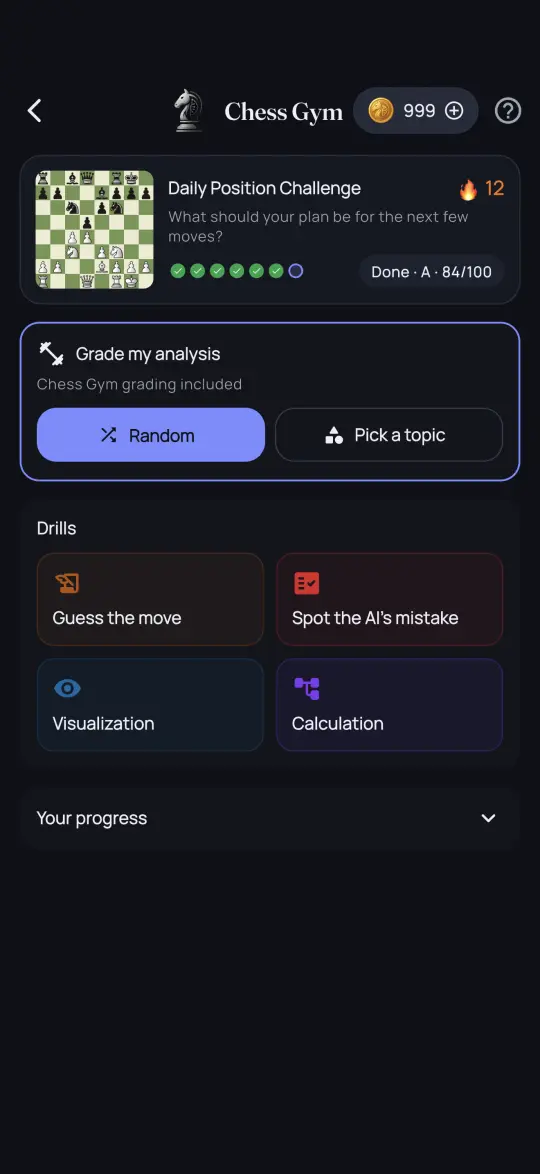
Chess GymWrite your own analysis and get it graded, with drills for calculation and visualization.
IQChess app: Kai catches a blunder
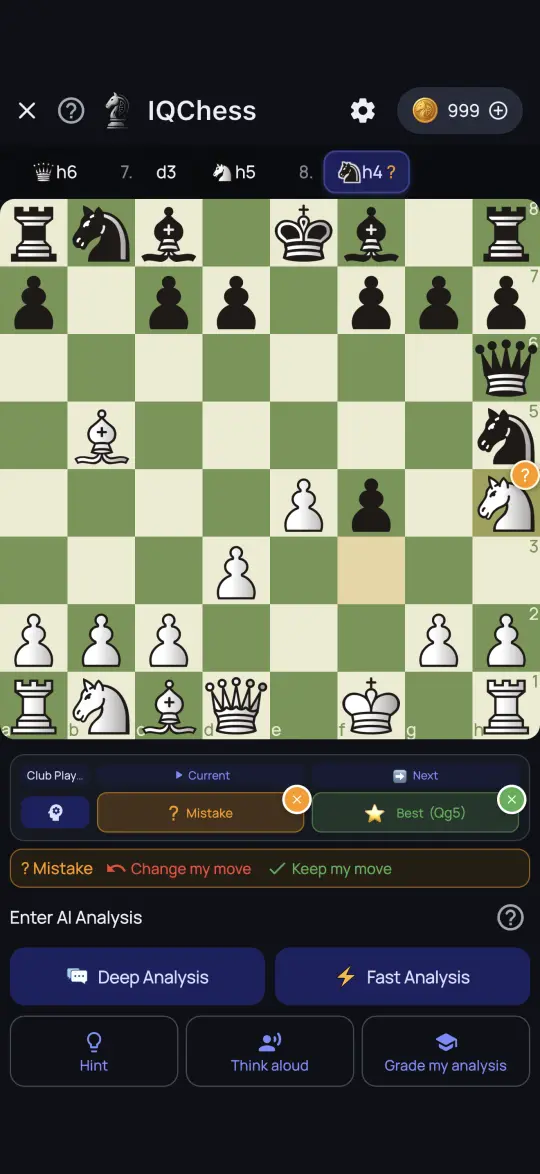
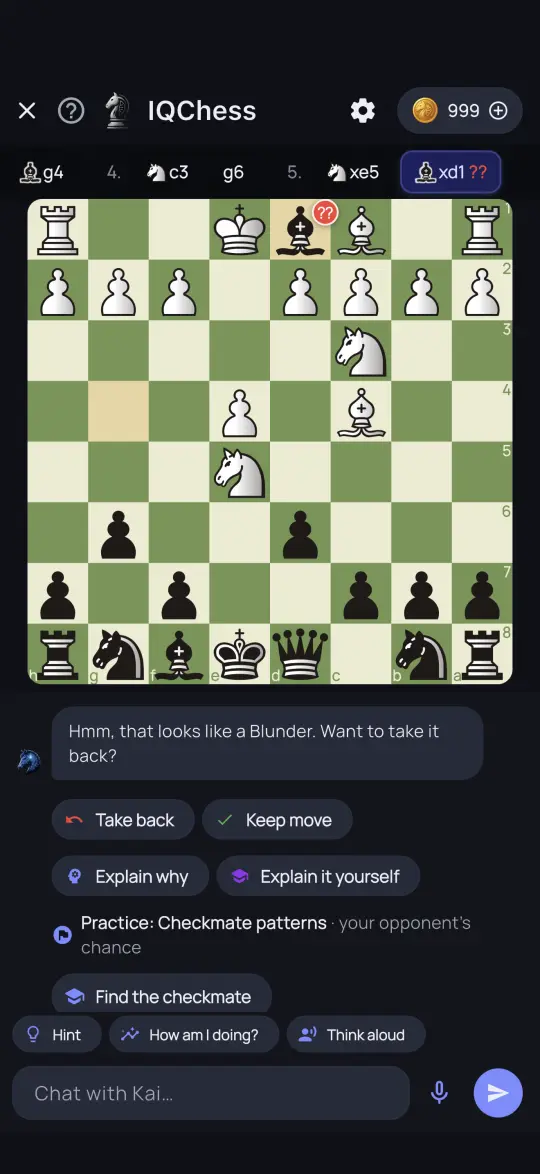
Kai catches a blunderKai stops a losing move and offers to take it back or explain it.
IQChess app: Ask Kai anything
Ask Kai anythingKai answers about the game you are playing, in your language.
IQChess app: AI analysis
AI analysisCandidate moves, threats and plans, every move checked by the engine.
IQChess app: Game report
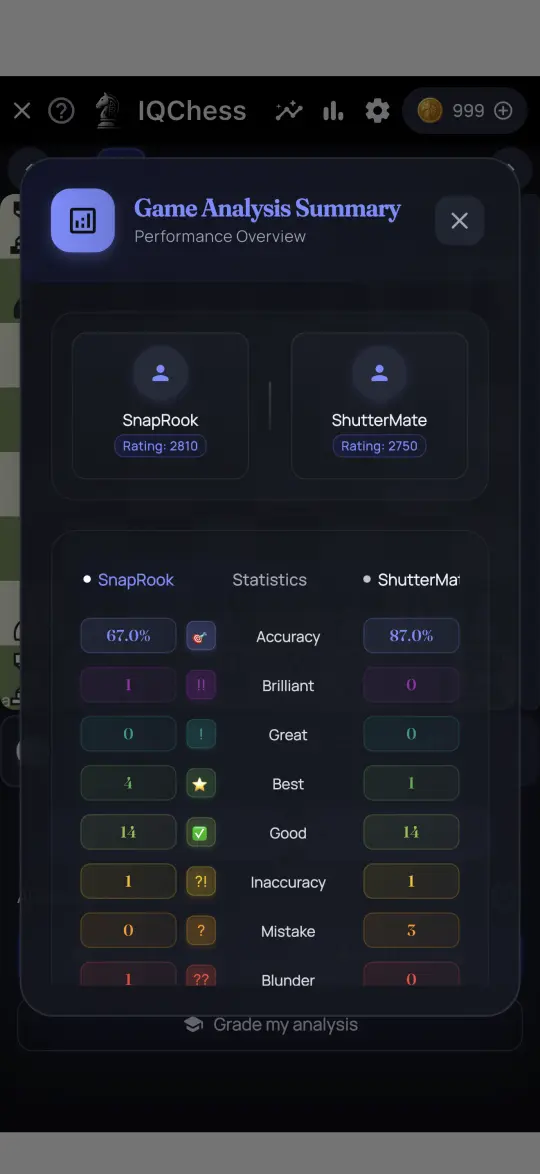
Game reportAccuracy for both sides and the moments that decided the game.
IQChess app: Your coach
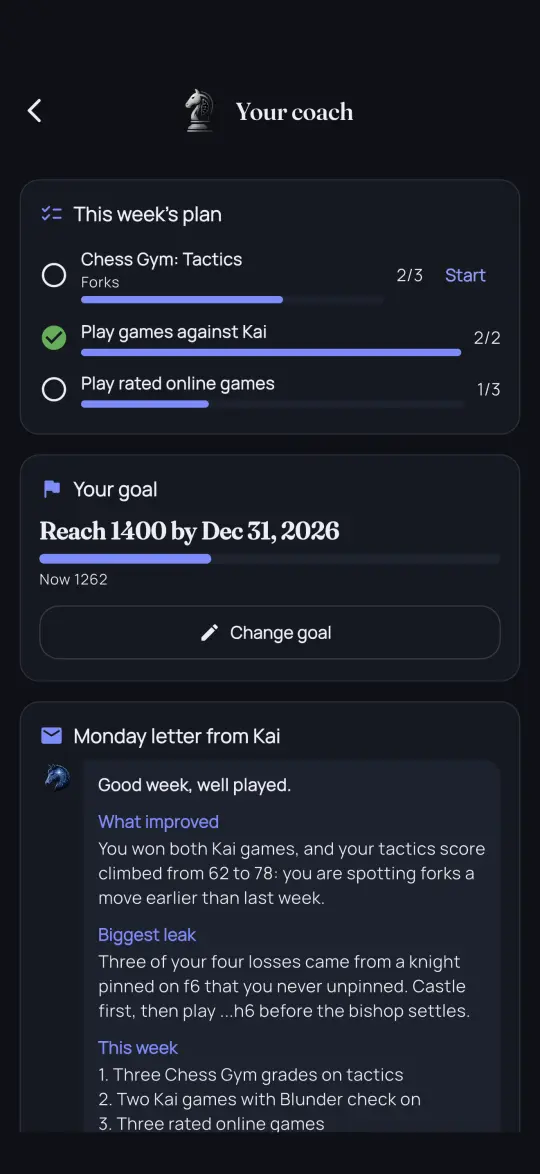
Your coachA goal, a weekly plan and the themes you lose most games to.
IQChess app: Play the computer
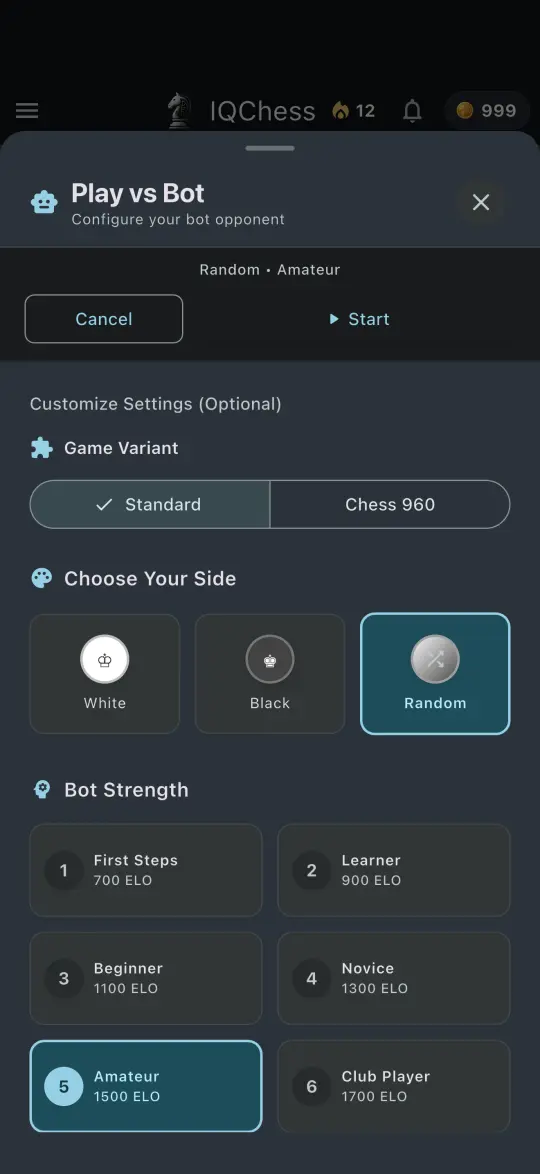
Play the computerTen bot levels, from a complete beginner to seriously strong.
IQChess app: Everything in one app
Everything in one appPlay, puzzles, lessons, the Chess Gym and online games.
FAQ

Questions, answered

Still curious? Read every answer.

Can an AI really coach chess?

Yes, when the AI explains facts it is given instead of guessing. In IQChess every move, evaluation and tactic comes from a chess engine and board logic; the AI writes the explanation and answers follow-up questions about the same position.

Is the AI chess coach free?

Everyone gets a daily allowance of AI analysis for free. Coach and GM plans include more: Coach covers fast analysis, GM covers fast and deep analysis, from US$10.99 a month.

How is this chess AI different from a chess engine?

A chess engine searches millions of positions and returns an evaluation and a best line; it has no words. IQChess's chess AI starts from that engine output and from board logic, then explains it: which piece is loose, what the threat is, why the best move works. The engine supplies the truth, the AI supplies the reason.

Does the AI make up moves?

No. Every move in an answer is checked for legality against the position, and claims about the engine's lines are checked against what those lines actually do; anything that fails is rewritten or removed. The AI is given the facts, it does not invent them.

Can I ask the chess AI follow-up questions?

Yes. Deep analysis is a conversation about the position: ask why, what if, or what to play instead, and quick prompts such as "What should I do here?" are one tap. Arrows show the moves on the board.

Which languages does the AI coach speak?

More than 20, including English, Spanish, Portuguese, French, German, Russian, Arabic, Persian, Hindi, Chinese, Japanese and Korean. Answers come in the language you write in.

Can I use the AI coach on games from Chess.com or Lichess?

Yes. Import any game as PGN and tap a move: Fast analysis explains that move, Deep analysis opens a conversation, and the game report reviews the whole game.

Is the AI coach the same as Kai?

No. Kai is the chess AI you play against and chat with during a game; the AI coach explains positions and answers questions about them. When a question in Kai's chat needs real analysis, Kai offers the coach's Deep analysis right there.

Free lessons

91 lessons, from zero to advanced

The chessboardRows, columns and the centreSetting up the piecesThe rookThe bishopThe queenThe kingThe knightThe pawnPut it togetherHow to captureUnder attackProtecting your piecesCheckGetting out of checkCheckmateFind the checkmateStalemateCastlingPromotionEn passantWhat the pieces are worthDrawsStarting the game wellMate with king and queenThe rook ladderNaming the squaresWriting down movesYour first gameTake the free pieceDon't hang your ownWin materialBack-rank mateFind the checkmateSmothered mateKing and queenKing and rookTrap a pieceFight for the centreDevelop your piecesThe four-move checkmateCastle earlyThe Fool's MateLégal's MateSmothered in the openingThe Blackburne Shilling trapPunish a weak pawn moveHolding the gambit pawnWhat is a fork?Knight forksPawn forksQueen forksSpot the forkWhat is a pin?Winning with pinsWhat is a skewer?Skewer practiceWhat is a discovered attack?Discovered attack practiceCapture the defenderDeflectionThe oppositionThe rule of the squareThe Englund Gambit trapThe Kieninger trapThe Stafford Gambit trapThe Elephant trapNoah's Ark trapThe Fishing PoleThe Siberian trapThe Lasker trapThe copycat trapWeak pawnsPassed pawnsOutpostsGood and bad bishopsOpen filesDouble checkAttractionMate in twoThe Lucena positionPush the passed pawnSacrifice to winClearanceInterferenceX-rayQuiet movesZugzwangLong combinationsMate in threeConverting the endgameThe chessboardRows, columns and the centreSetting up the piecesThe rookThe bishopThe queenThe kingThe knightThe pawnPut it togetherHow to captureUnder attackProtecting your piecesCheckGetting out of checkCheckmateFind the checkmateStalemateCastlingPromotionEn passantWhat the pieces are worthDrawsStarting the game wellMate with king and queenThe rook ladderNaming the squaresWriting down movesYour first gameTake the free pieceDon't hang your ownWin materialBack-rank mateFind the checkmateSmothered mateKing and queenKing and rookTrap a pieceFight for the centreDevelop your piecesThe four-move checkmateCastle earlyThe Fool's MateLégal's MateSmothered in the openingThe Blackburne Shilling trapPunish a weak pawn moveHolding the gambit pawnWhat is a fork?Knight forksPawn forksQueen forksSpot the forkWhat is a pin?Winning with pinsWhat is a skewer?Skewer practiceWhat is a discovered attack?Discovered attack practiceCapture the defenderDeflectionThe oppositionThe rule of the squareThe Englund Gambit trapThe Kieninger trapThe Stafford Gambit trapThe Elephant trapNoah's Ark trapThe Fishing PoleThe Siberian trapThe Lasker trapThe copycat trapWeak pawnsPassed pawnsOutpostsGood and bad bishopsOpen filesDouble checkAttractionMate in twoThe Lucena positionPush the passed pawnSacrifice to winClearanceInterferenceX-rayQuiet movesZugzwangLong combinationsMate in threeConverting the endgame

Browse all lessons →

Start playing smarter today

Play, learn and get every move explained in plain language. Free on iPhone, Android and the web.