Chess Gym

Chess Gym: train how you think

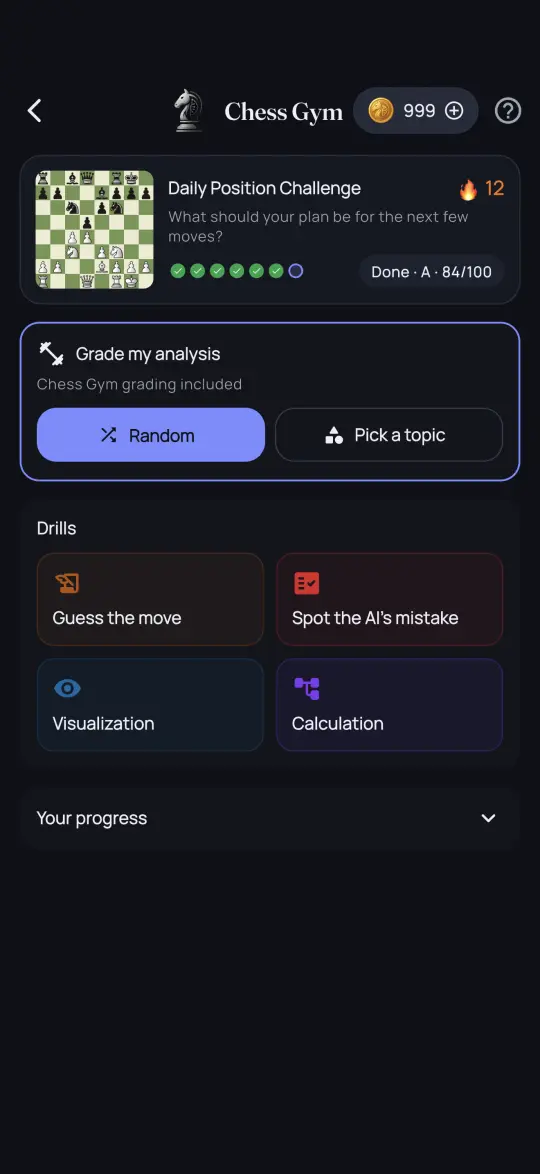
The Chess Gym trains the thinking behind good moves. You write your own analysis of a position, on a topic like the best move, king safety or the opponent's threat, and get a 0-100 grade with the key points you found, the ones you missed and a model answer.

Free on iPhone, Android and the web · 20+ languages

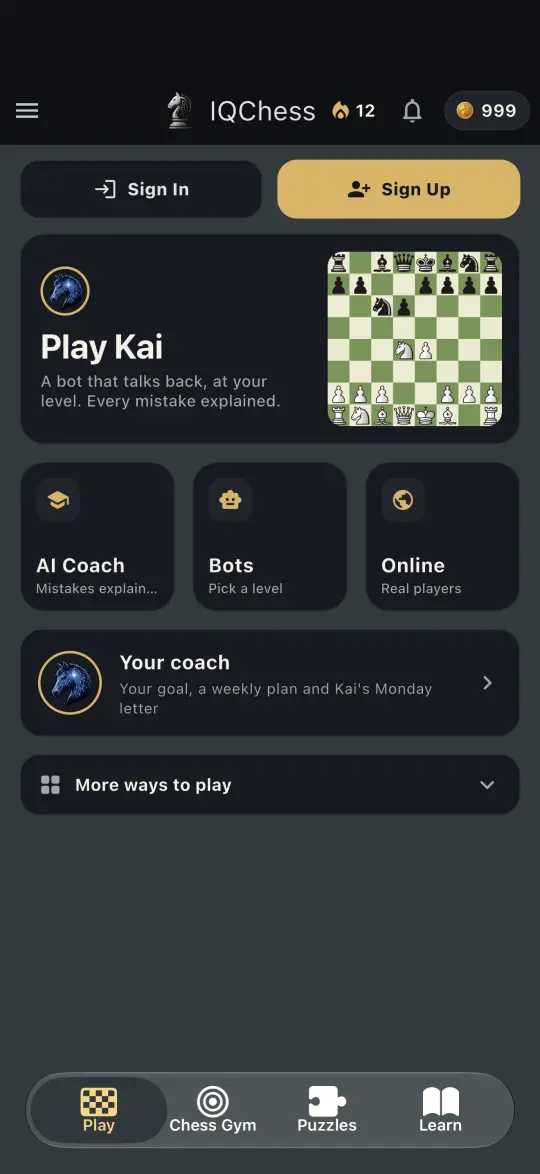
IQChess app: Everything in one app
IQChess app: Chess Gym
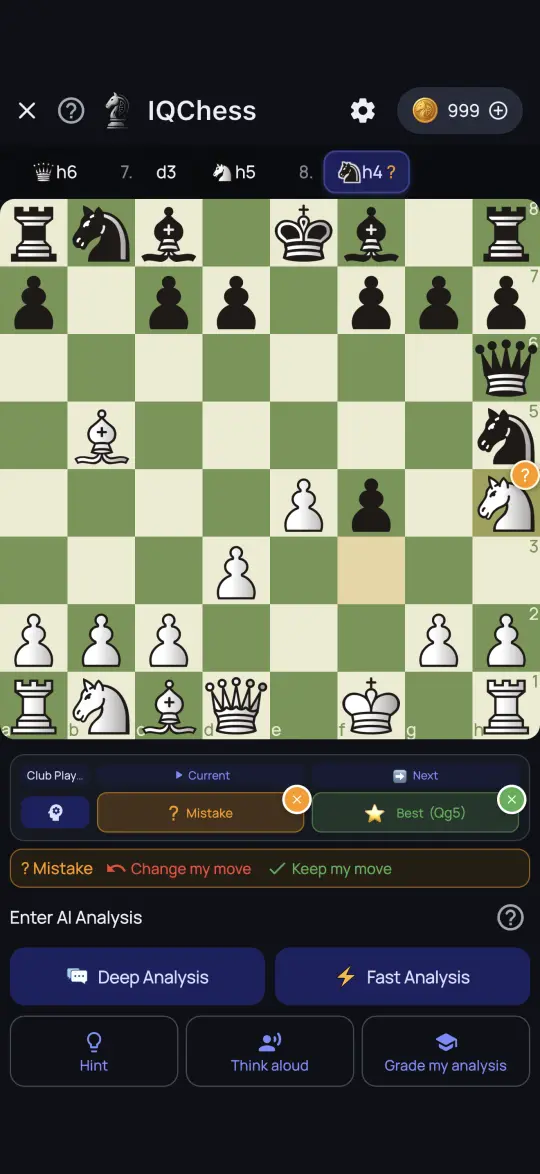
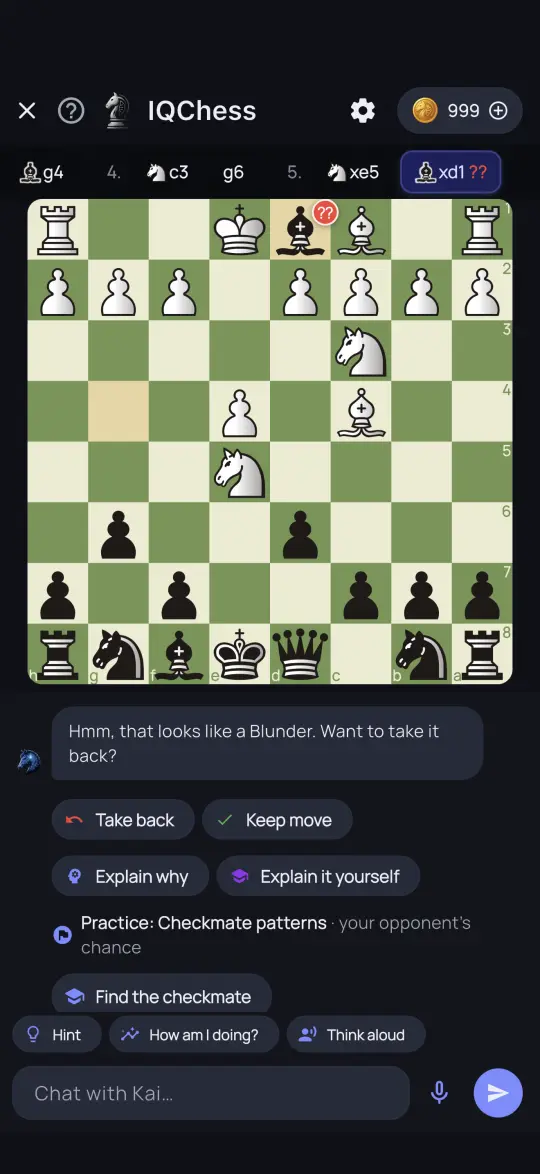
IQChess app: Kai catches a blunder
Every move checked by a chess engine
Answers in your language
91free lessons
10bot levels
20+languages
3platforms
How it works

What it does for your game

Write your own analysis of a chess position and get it graded 0-100, every claim checked by an engine. Plus move, mistake and calculation drills.

How grading works

The key points come from a chess engine and board logic, never from the AI's memory. The AI only marks which points your answer hit, and every move you mention is checked for legality, so a correct idea is never called illegal.
Drills

Guess the move replays real master games and asks for the next move. Spot the AI's mistake hides false statements in an analysis of a real position for you to find. Visualization asks what is on a square after moves you cannot see. Calculation shows a frozen board and asks you to play a whole tactic in your head.

Daily challenge

One position a day, free for everyone, with your score compared to everyone else who tried it. A streak, weekly goals and your weakest topics keep the training going.

The exercises

Every exercise in the Chess Gym

Four quick drills with no typing, a daily challenge, and 14 topics where you write your own analysis and get it graded.

Guess the move

Famous games — find the master's move.

ExampleThe Game of the Century: Donald Byrne vs Bobby Fischer, New York 1956. What did Fischer play here? Make your move on the board.

Show the answer

: Fischer gives up his queen. After he takes a rook, two bishops and a pawn for it, and his pieces swarm the white king.

Tap a move to play it on the board.

Spot the AI's mistake

An analysis with planted errors — find them.

ExampleThe Elephant Trap: White has just won a pawn with 6.Nxd5? False statements hidden in this analysis: 1


  • White is ahead in material (+1).
  • The knight on f6 is pinned to its King.
  • Black's strongest move is nxd5.
Show the answer

In fact: The bishop on g5 pins the knight on f6 to the queen. So and Black wins a piece for the pawn.

Tap a move to play it on the board.

Visualization

Follow the moves in your head — no board.

ExampleThe board stays on the starting position. Moves: 1.e4 e5 2.Nf3 d6 3.Bc4 Bg4 4.Nc3 g6 5.Nxe5 Bxd1 6.Bxf7+ Ke7 7.Nd5#. Where is Black's king at the end, and why is the game over?

Show the answer

On e7, and it is checkmate: Légal's trap. White gave up the queen on move 5 to get there.

Tap a move to play it on the board.

Calculation

Solve a tactic move by move — the board never moves.

ExampleRéti vs Tartakower, Vienna 1910. White to play and mate in three. Tap each move; the board never moves.

Show the answer

: the queen sacrifice pulls the king to d8, the bishop gives double check, and the other bishop mates (after 10…ke8, 11.Rd8#).

Tap a move to play it on the board.

Daily challenge

Analyze today's position — free once a day

Write your analysis, get a grade from 0 to 100

Pick a topic, write or say what you see, and get a score, the points you found and missed, any false claims and a model answer.

  • Best moveWhat's the best move, and why?
  • Who's better?Who is better here, and why?
  • King safetyHow safe are both kings?
  • Pawn structureDescribe the pawn structure. What does it mean for both sides?
  • TacticsDo you see any tactical ideas?
  • Opponent's threatWhat is your opponent threatening?
  • PlanWhat should your plan be for the next few moves?
  • Explain the mistakeA real blunder — explain what it allowed.
  • Teach KaiKai is about to blunder. Explain why.
  • Candidate movesPick up to 3 candidate moves on the board — and say why.
  • Endgame techniqueYou're winning. What's the winning method, and your first move?
  • Structure plansIQP, Carlsbad, Maroczy — know the plans.
  • ImbalancesWho stands better? Name the key imbalances.
  • Opening ideasThe ideas behind famous opening moves.
Get started

Three steps to start

  1. Open the Chess Gym and pick the daily challenge or a topic.
  2. Write or say what you see in the position.
  3. Read your grade, the points you missed and the model answer.
Inside the app

See it on your phone

Real IQChess screens. Swipe, or tap one to see it full size.
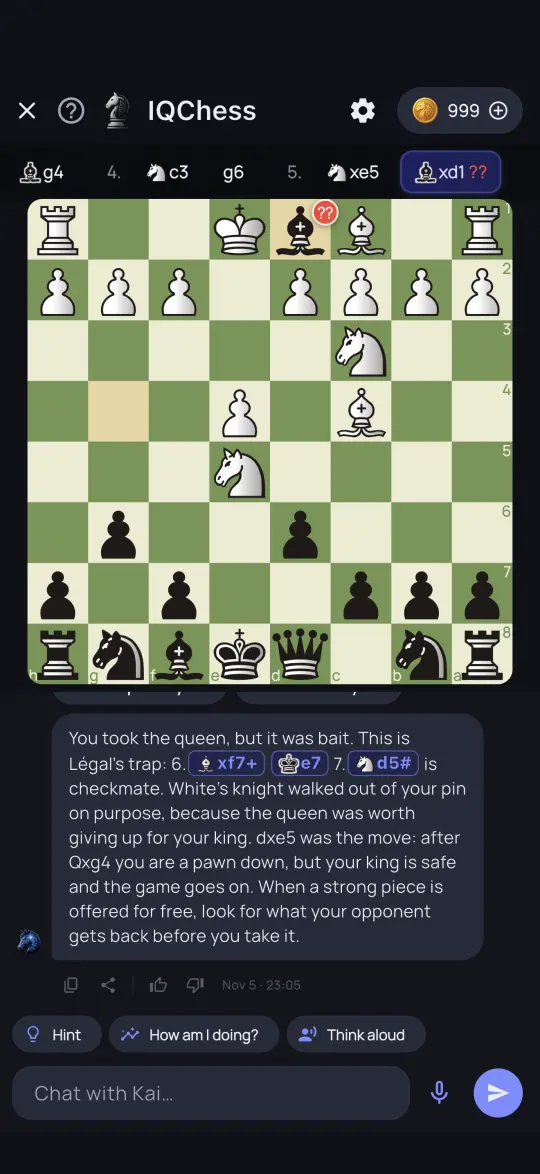
IQChess app: Kai catches a blunder
Kai catches a blunderKai stops a losing move and offers to take it back or explain it.
IQChess app: Ask Kai anything
Ask Kai anythingKai answers about the game you are playing, in your language.
IQChess app: AI coach while you play
AI coach while you playFast and Deep analysis on any move, with the reason in plain words.
IQChess app: AI analysis
AI analysisCandidate moves, threats and plans, every move checked by the engine.
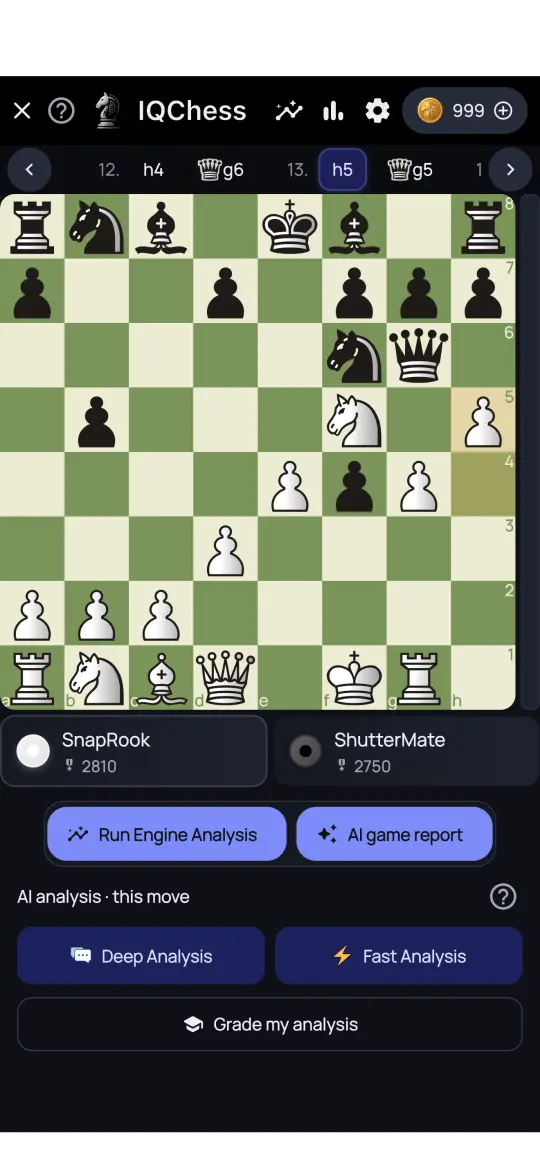
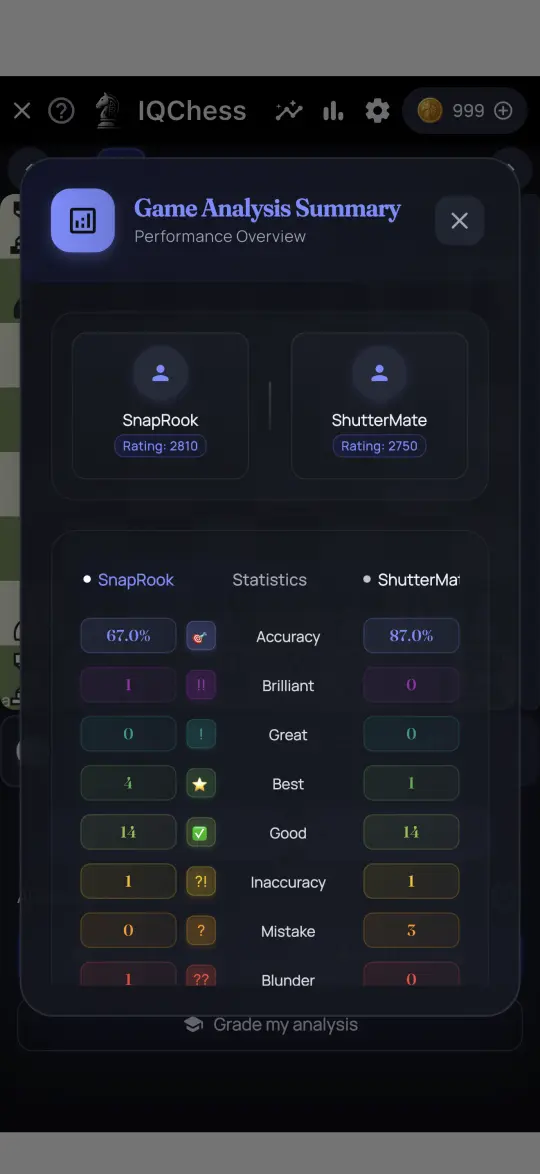
IQChess app: Game report
Game reportAccuracy for both sides and the moments that decided the game.
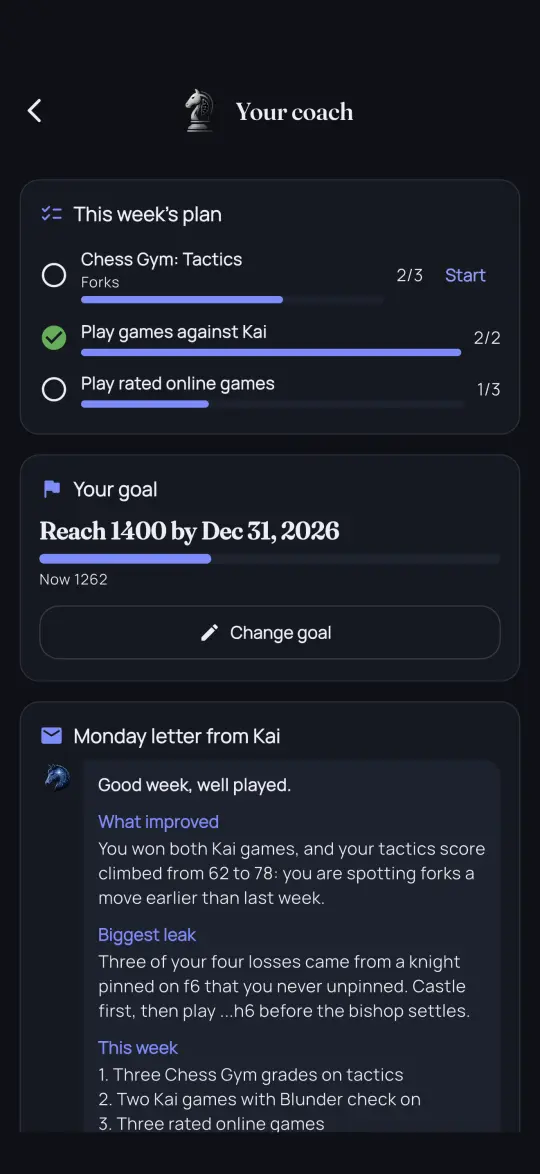
IQChess app: Your coach
Your coachA goal, a weekly plan and the themes you lose most games to.
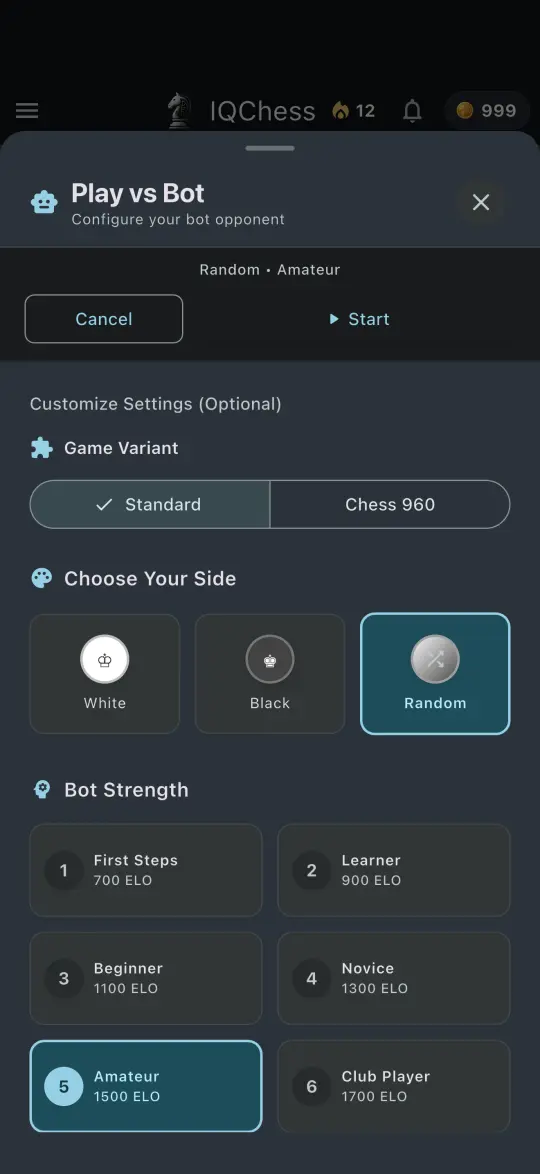
IQChess app: Play the computer
Play the computerTen bot levels, from a complete beginner to seriously strong.
IQChess app: Everything in one app
Everything in one appPlay, puzzles, lessons, the Chess Gym and online games.
FAQ

Questions, answered

Still curious? Read every answer.

What is the Chess Gym?

The Chess Gym is IQChess's training area for chess thinking. You analyse positions in your own words and an AI grades the answer against engine-checked key points, plus drills for move guessing, spotting mistakes, visualization and calculation.

Is the Chess Gym free?

The daily challenge is free for everyone. Free players get a daily allowance of drills; any plan makes drills unlimited, and GM includes AI grading.

Can I answer by voice?

Yes. Tap the microphone and say your analysis; your phone turns it into text, you check the transcript, and then it is graded.

Which topics can I write about?

Fourteen: best move, evaluation, king safety, pawn structure, tactics, the opponent's threat, plan, spot the mistake, teach Kai, candidate moves, endgame, structure and plans, imbalances, and why an opening move is played.

What if I mention a move that is illegal?

Every move you write is checked against the position before grading, so a legal move is never marked illegal, and a false claim is listed next to the fact that contradicts it. The grade is assembled from those checks, not from the AI's impression.

Free lessons

91 lessons, from zero to advanced

The chessboardRows, columns and the centreSetting up the piecesThe rookThe bishopThe queenThe kingThe knightThe pawnPut it togetherHow to captureUnder attackProtecting your piecesCheckGetting out of checkCheckmateFind the checkmateStalemateCastlingPromotionEn passantWhat the pieces are worthDrawsStarting the game wellMate with king and queenThe rook ladderNaming the squaresWriting down movesYour first gameTake the free pieceDon't hang your ownWin materialBack-rank mateFind the checkmateSmothered mateKing and queenKing and rookTrap a pieceFight for the centreDevelop your piecesThe four-move checkmateCastle earlyThe Fool's MateLégal's MateSmothered in the openingThe Blackburne Shilling trapPunish a weak pawn moveHolding the gambit pawnWhat is a fork?Knight forksPawn forksQueen forksSpot the forkWhat is a pin?Winning with pinsWhat is a skewer?Skewer practiceWhat is a discovered attack?Discovered attack practiceCapture the defenderDeflectionThe oppositionThe rule of the squareThe Englund Gambit trapThe Kieninger trapThe Stafford Gambit trapThe Elephant trapNoah's Ark trapThe Fishing PoleThe Siberian trapThe Lasker trapThe copycat trapWeak pawnsPassed pawnsOutpostsGood and bad bishopsOpen filesDouble checkAttractionMate in twoThe Lucena positionPush the passed pawnSacrifice to winClearanceInterferenceX-rayQuiet movesZugzwangLong combinationsMate in threeConverting the endgameThe chessboardRows, columns and the centreSetting up the piecesThe rookThe bishopThe queenThe kingThe knightThe pawnPut it togetherHow to captureUnder attackProtecting your piecesCheckGetting out of checkCheckmateFind the checkmateStalemateCastlingPromotionEn passantWhat the pieces are worthDrawsStarting the game wellMate with king and queenThe rook ladderNaming the squaresWriting down movesYour first gameTake the free pieceDon't hang your ownWin materialBack-rank mateFind the checkmateSmothered mateKing and queenKing and rookTrap a pieceFight for the centreDevelop your piecesThe four-move checkmateCastle earlyThe Fool's MateLégal's MateSmothered in the openingThe Blackburne Shilling trapPunish a weak pawn moveHolding the gambit pawnWhat is a fork?Knight forksPawn forksQueen forksSpot the forkWhat is a pin?Winning with pinsWhat is a skewer?Skewer practiceWhat is a discovered attack?Discovered attack practiceCapture the defenderDeflectionThe oppositionThe rule of the squareThe Englund Gambit trapThe Kieninger trapThe Stafford Gambit trapThe Elephant trapNoah's Ark trapThe Fishing PoleThe Siberian trapThe Lasker trapThe copycat trapWeak pawnsPassed pawnsOutpostsGood and bad bishopsOpen filesDouble checkAttractionMate in twoThe Lucena positionPush the passed pawnSacrifice to winClearanceInterferenceX-rayQuiet movesZugzwangLong combinationsMate in threeConverting the endgame

Browse all lessons →

Start playing smarter today

Play, learn and get every move explained in plain language. Free on iPhone, Android and the web.