 IQChess

IQChess questions and answers
Short answers about the IQChess chess app: what it does, what it costs and how its AI works.
Is IQChess free?
Yes. IQChess is free to download and play on iOS, Android and the web. Bot games, online play, daily puzzles and all 91 Learn lessons need no subscription. Optional plans (Arena, Coach and GM, from US$6.99 a month) add unlimited AI Coach and Kai games and more AI analysis.
What is IQChess?
IQChess is a chess app with an AI coach that explains moves in plain language. You can play the computer or people online, solve daily puzzles, take free lessons from zero, train in the Chess Gym and get an AI report on any game. It runs on iPhone, Android and the web, in 20+ languages.
Who makes IQChess?
IQChess is made by 9517-9206 Québec inc., a company in Montreal, Canada. The app launched in 2025.
Can an AI really coach chess?
Yes, when the AI explains facts it is given instead of guessing. In IQChess every move, evaluation and tactic comes from a chess engine and board logic; the AI writes the explanation and answers follow-up questions about the same position.
Is the AI chess coach free?
Everyone gets a daily allowance of AI analysis for free. Coach and GM plans include more: Coach covers fast analysis, GM covers fast and deep analysis, from US$10.99 a month.
How is this chess AI different from a chess engine?
A chess engine searches millions of positions and returns an evaluation and a best line; it has no words. IQChess's chess AI starts from that engine output and from board logic, then explains it: which piece is loose, what the threat is, why the best move works. The engine supplies the truth, the AI supplies the reason.
Does the AI make up moves?
No. Every move in an answer is checked for legality against the position, and claims about the engine's lines are checked against what those lines actually do; anything that fails is rewritten or removed. The AI is given the facts, it does not invent them.
Can I ask the chess AI follow-up questions?
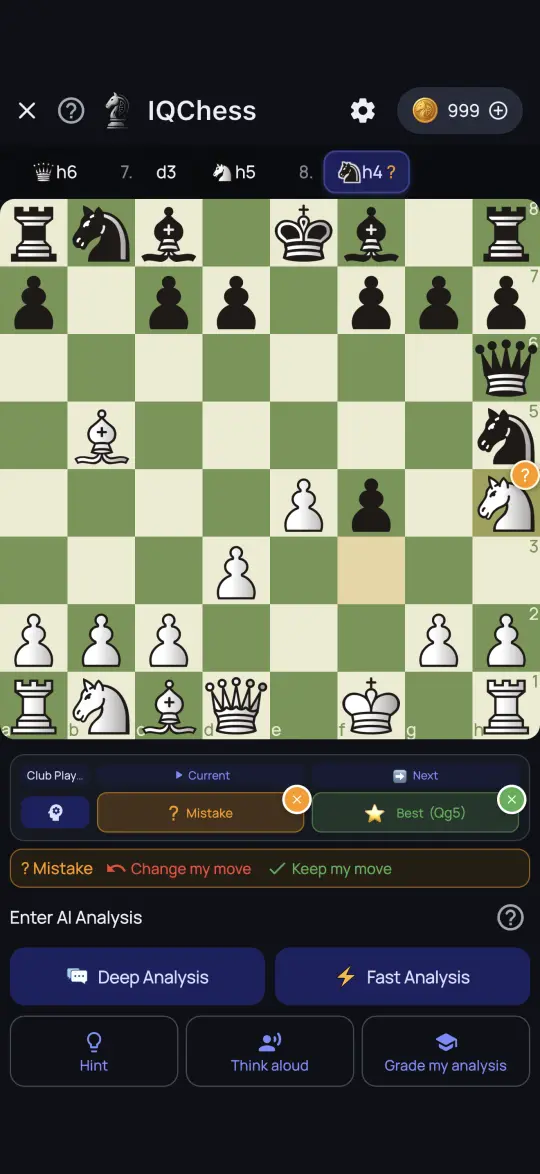
Yes. Deep analysis is a conversation about the position: ask why, what if, or what to play instead, and quick prompts such as "What should I do here?" are one tap. Arrows show the moves on the board.
Which languages does the AI coach speak?
More than 20, including English, Spanish, Portuguese, French, German, Russian, Arabic, Persian, Hindi, Chinese, Japanese and Korean. Answers come in the language you write in.
Can I use the AI coach on games from Chess.com or Lichess?
Yes. Import any game as PGN and tap a move: Fast analysis explains that move, Deep analysis opens a conversation, and the game report reviews the whole game.
Is the AI coach the same as Kai?
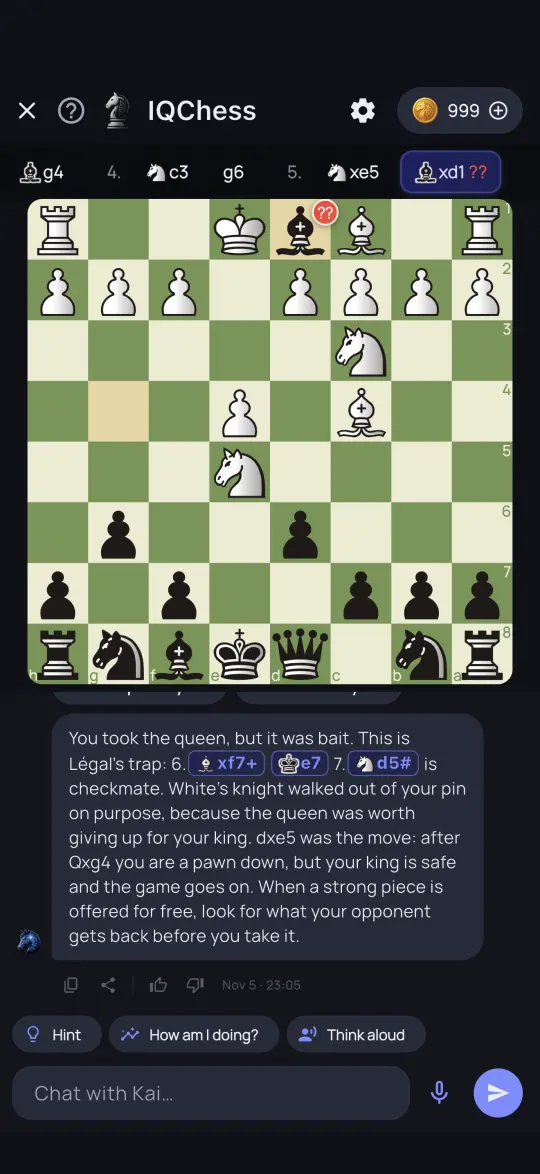
No. Kai is the chess AI you play against and chat with during a game; the AI coach explains positions and answers questions about them. When a question in Kai's chat needs real analysis, Kai offers the coach's Deep analysis right there.
Is Kai free?
Free players get one Kai game a day. Arena, Coach and GM plans include unlimited Kai games, from US$6.99 a month.
What does Kai mean?
Kai is short for Caïssa, the muse of chess. It is the name of the bot you play and chat with in IQChess.
Can I play chess against an AI for free?
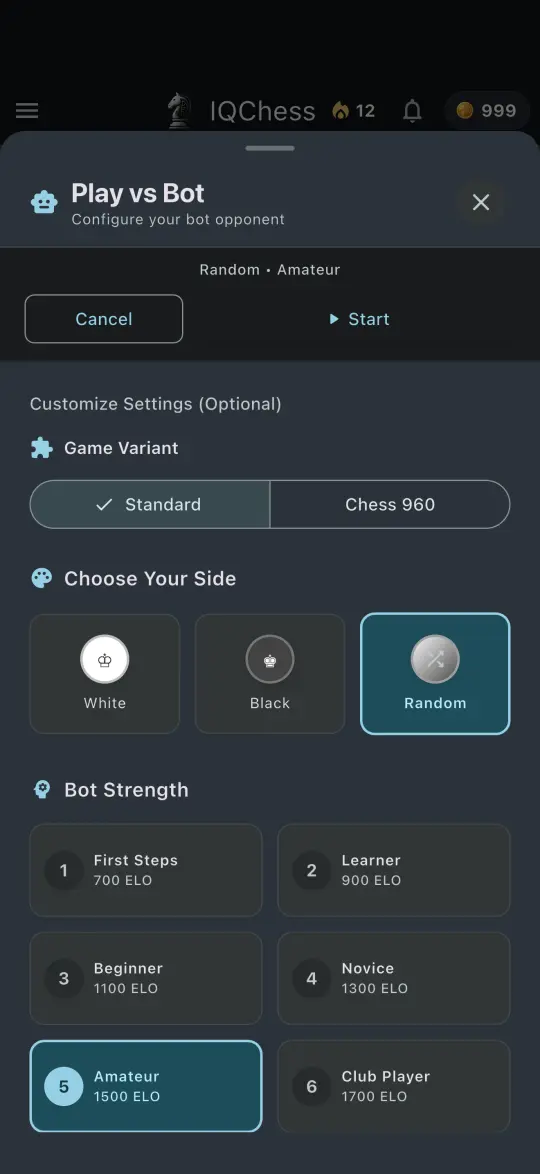
Yes. Free players get one Kai game a day, plus unlimited games against the plain computer at 10 levels. Arena, Coach and GM include unlimited Kai games.
How strong is Kai?
Kai's moves come from a chess engine set to one of 10 levels. Level 1 plays like someone who has just learned the rules; level 10 is seriously strong. Change the level any time by telling Kai.
Does Kai choose its own moves?
The moves come from a chess engine running on your device; Kai's voice is an AI that sees the board and the game so far. The engine decides, Kai explains and reacts.
Can Kai help me during the game?
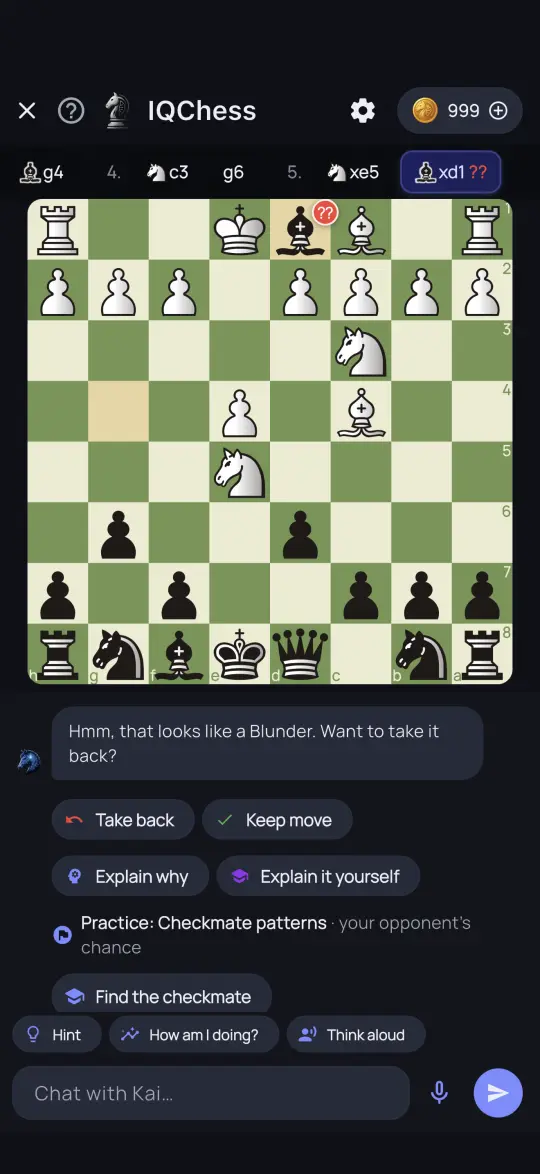
Yes: hints that point at a piece rather than giving the move away, a takeback after a mistake, and Fast or Deep analysis when a question needs real engine work.
How do I analyze my chess games for free?
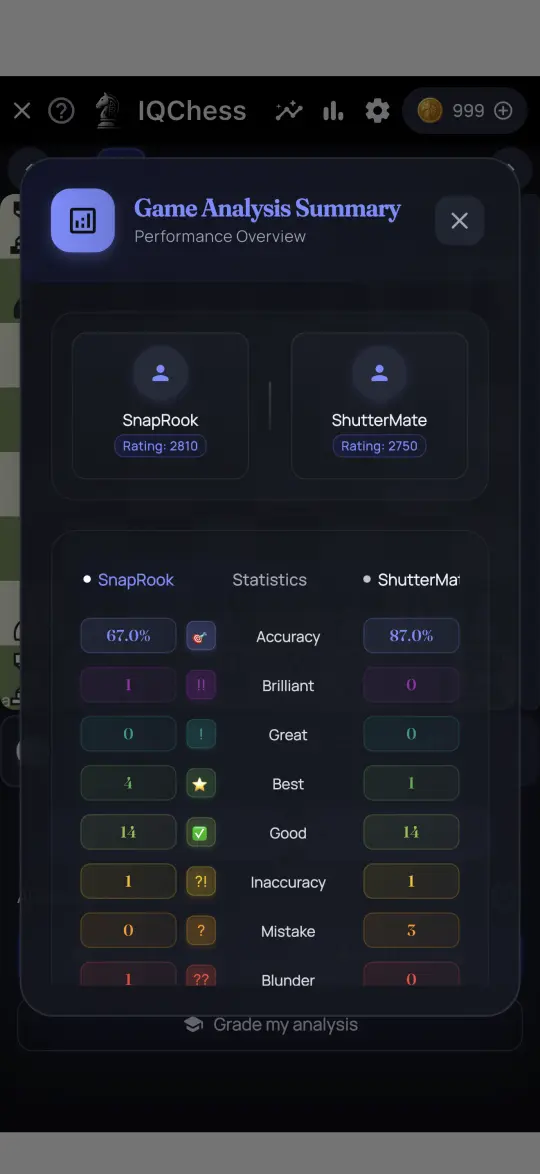
In IQChess free players get one move-by-move engine review a day, with accuracy and move classifications; any plan makes it unlimited. The AI game report costs 1-2 tokens for standard, or is included with the Coach and GM plans.
Can I analyze games from other sites?
Yes. Import any game as PGN, including games exported from Chess.com or Lichess, and analyze it like a game played in the app.
What counts as a blunder, a mistake or an inaccuracy?
Each move is compared with the engine's best move by how much it changes the chance of winning: a small drop is an inaccuracy, a bigger one a mistake, a large one a blunder. A move as good as the engine's is best, and a hard-to-find winning move is brilliant.
Can I ask questions about my game after the report?
Yes. Ask Kai about this game opens a chat that has the whole report: ask which moves were bad, what you should have played on move 12, or why a move was a mistake.
How long does a game report take?
Usually under half a minute: the engine checks every move, then the AI writes the report. Finished reports are saved, so opening the same one again is instant and free.
What is the Chess Gym?
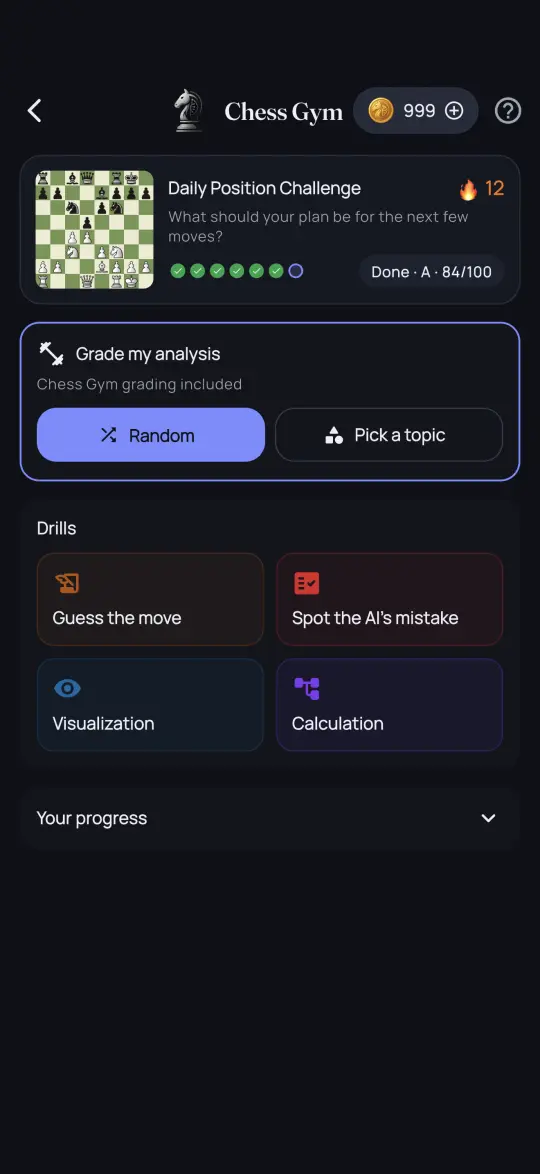
The Chess Gym is IQChess's training area for chess thinking. You analyse positions in your own words and an AI grades the answer against engine-checked key points, plus drills for move guessing, spotting mistakes, visualization and calculation.
Is the Chess Gym free?
The daily challenge is free for everyone. Free players get a daily allowance of drills; any plan makes drills unlimited, and GM includes AI grading.
Can I answer by voice?
Yes. Tap the microphone and say your analysis; your phone turns it into text, you check the transcript, and then it is graded.
Which topics can I write about?
Fourteen: best move, evaluation, king safety, pawn structure, tactics, the opponent's threat, plan, spot the mistake, teach Kai, candidate moves, endgame, structure and plans, imbalances, and why an opening move is played.
What if I mention a move that is illegal?
Every move you write is checked against the position before grading, so a legal move is never marked illegal, and a false claim is listed next to the fact that contradicts it. The grade is assembled from those checks, not from the AI's impression.
Are the chess puzzles free?
Yes. The daily tactical and positional puzzles are free, and free players also get a daily set of practice puzzles.
How are puzzles chosen for my level?
Each puzzle type has its own Glicko-2 rating. Practice puzzles are picked at random from a band around your rating, so they get harder as you improve.
What is the difference between tactical and positional puzzles?
Tactical puzzles have a forcing answer: a fork, pin, skewer, discovered attack or mate that wins by force. Positional puzzles ask for the best long-term move, such as improving a piece or fixing a pawn weakness, with no immediate win.
Does my puzzle rating go down when I fail?
Yes, like a game rating: every attempt, solved or not, moves your Glicko-2 rating, by less as it settles. Tactical and positional puzzles are rated separately.
What happens to my streak if I miss a day?
A streak freeze, bought with gems you earn at streak milestones and from referrals, covers a missed day. Without one the streak starts again from zero.
Is there a chess IQ test?
No standard chess IQ test exists. Chess strength is measured by ratings like Elo or Glicko-2 and by game accuracy. IQChess gives you puzzle and game ratings, accuracy for every game and Chess Gym scores, which together show your level and what to train.
Does playing chess raise your IQ?
Not measurably. A 2016 meta-analysis of chess training studies (Sala and Gobet, Educational Research Review, vol. 18) found that well-controlled studies show little transfer to general skills. Chess does build chess-specific skills, such as calculation, pattern recognition and planning, and those improve with practice.
What does my score on the chess IQ check mean?
Six positions are a snapshot, not a rating. Zero to two right is beginner territory, three or four is an improving player, five or six is club strength. Rated games and puzzles in the app measure the same skill over hundreds of positions.
What is a good chess rating?
Most people who play online are rated somewhere between 800 and 1500, depending on the site; above 2000 you are in a small minority, and FIDE titles start at 2200. A good rating is one that is higher than it was last month.
What is the difference between Elo and Glicko-2?
Both estimate strength from results. Elo moves your rating by a fixed share of the surprise in each game. Glicko-2 also tracks how certain the rating is, so a new player's rating moves fast and settles as the uncertainty shrinks. IQChess uses Elo for online games and Glicko-2 for puzzles.
How does IQChess measure my chess IQ?
With ratings for online games and for each puzzle type, an accuracy percentage for every game, 0-100 Chess Gym scores by topic, and a weak-spots list of the themes that cost you the most games. None of it is an IQ score; all of it shows what to train next.
Do grandmasters have high IQs?
Some do, but the research link between cognitive ability and chess skill is modest and weaker in stronger players. Expert strength is mostly trained knowledge: thousands of patterns, recognised fast. That is good news, because it can be learned.
Is the chess IQ check free?
Yes. It runs on this page, with no account and no download. The app's puzzles, ratings and the daily Chess Gym challenge are free too.
Can I learn chess for free?
Yes. All 91 IQChess lessons are free and need no account. They start from the rules and go up to advanced tactics and endgames.
What is the best way to learn chess as a beginner?
Learn how the pieces move, then checkmate patterns, then basic tactics like forks and pins, and play short games in between. The IQChess course follows that order, one small idea per lesson.
How long does the course take?
Each lesson takes a few minutes; all 91 together are around ten hours. There is no schedule: progress is saved on your device and no lesson is locked.
Do I need an account to take the lessons?
No. The lessons work without an account and without an internet connection, on iPhone, Android and the web.
Which languages are the lessons in?
22: English, Arabic, Chinese (Simplified and Traditional), Dutch, French, German, Hebrew, Hindi, Indonesian, Italian, Japanese, Korean, Persian, Polish, Portuguese (Brazil and Portugal), Russian, Spanish, Thai, Turkish and Vietnamese.
Is IQChess safe for children?
School and club accounts start in kid-safe mode: students only play classmates, the teacher decides whether AI chat is on, students' data is never used to train AI, and young children can use class accounts without an email address.
How much does IQChess cost for a school?
US$49.99 per student per year (US$29.99 in many countries), minimum 10 seats, or US$6.99 for a seat without AI features. Every school can start with a free 30-day pilot of 10 seats.
Can students use IQChess without an email address?
Yes. Teachers create class accounts with a username and password, or print a QR card that signs a young child in with one scan. Removing a class account deletes the child's data.
Can a teacher turn the AI features off?
Yes. Kai chat, deep analysis and AI grading are each a switch for the teacher, and kid-safe mode is on by default for schools. Students' games are never used to train AI.
How do students join a class?
With a class code or link from the teacher. A student with their own email enters the code under Settings in the app and is placed in the class, using a seat the school already holds.
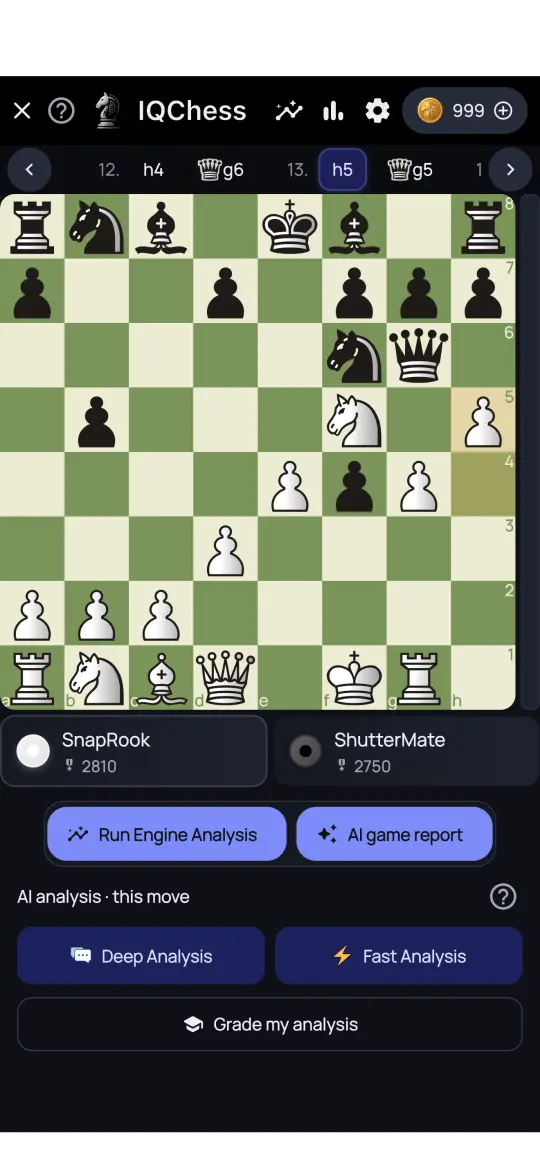
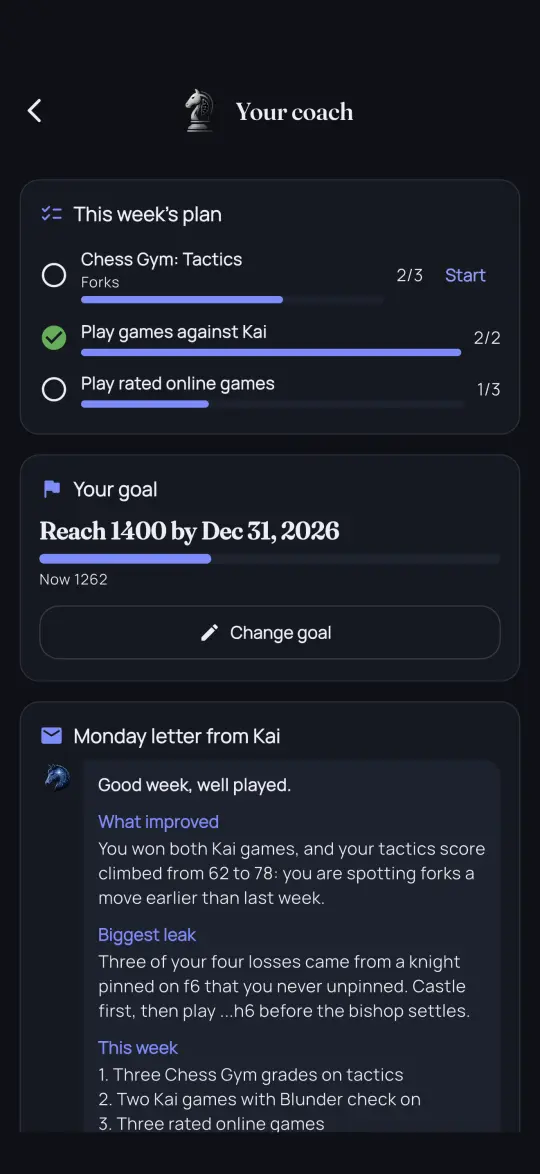
See it on your phone
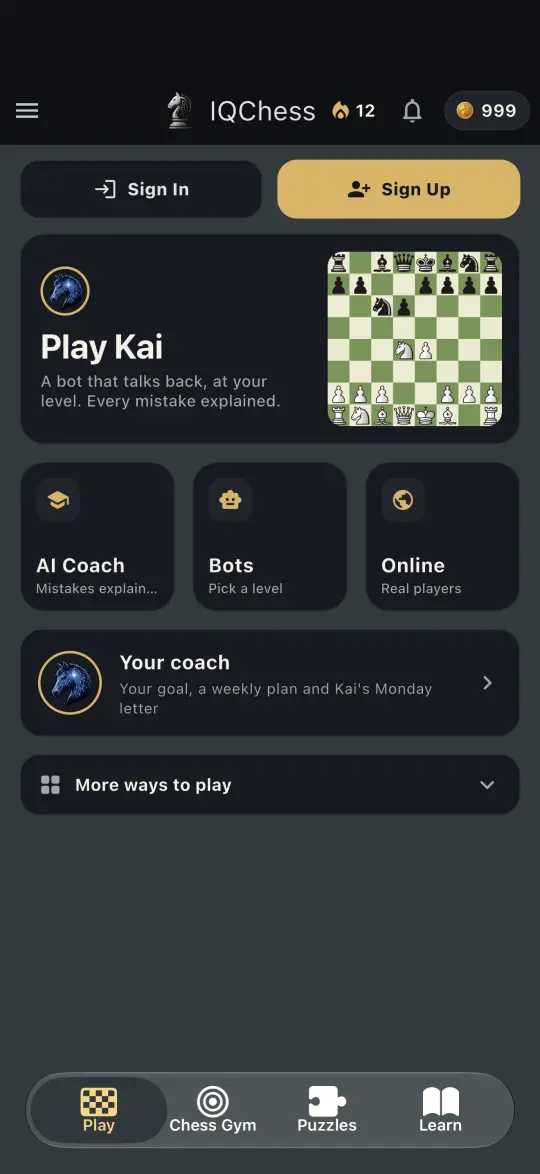
Real IQChess screens. Swipe, or tap one to see it full size.
Start playing smarter today
Play, learn and get every move explained in plain language. Free on iPhone, Android and the web.